More
    Home Blog Page 21

    Victoria Mboko Next Match: Bold Path, Tough Opponent

    0

    Victoria Mboko Next Match: Bright Future, Tough Test Ahead

    Victoria Mboko has quickly become one of the most exciting young names in women’s tennis. As fans wait for her next appearance on the court, curiosity is at an all-time high. Who is she playing next? What’s at stake? And how has she managed such an impressive rise before even turning twenty?

    Let’s dive into everything about Victoria Mboko next match, her latest form, what to expect from her next opponent, and why tennis experts believe she’s on the verge of breaking into the global spotlight.


    The Rise of a Canadian Tennis Prodigy

    Born in August 2006 in Toronto, Victoria Mboko has been in the tennis spotlight since her junior years. By 2025, she’s already claimed multiple notable wins and drawn comparisons to Canadian stars like Bianca Andreescu and Leylah Fernandez.

    Her recent victory at the 2025 National Bank Open in Montréal, where she defeated Naomi Osaka in the final, was the breakthrough moment that pushed her into the WTA’s top discussions.

    That win wasn’t a fluke. Her all-court style, composure under pressure, and athletic power are earning her a reputation as one of the most balanced young players on tour.


    Victoria Mboko’s Next Match: Date, Opponent, and Venue

    As per the latest schedule updates from live tennis trackers, Victoria Mboko’s next match is expected to take place in Hong Kong on October 28, 2025, where she’ll face Talia Gibson.

    It’s part of the WTA Hong Kong Open 2025, a key event that draws a mix of established names and rising stars.

    While schedules can change, most reliable tournament sources, including SofaScore and Scores24, list the Hong Kong date as the next confirmed appearance for Mboko.

    Match Details (Expected):

    • Tournament: WTA Hong Kong Open 2025
    • Round: Opening round (vs. Talia Gibson)
    • Date: October 28, 2025
    • Surface: Hard court
    • Location: Victoria Park Tennis Stadium, Hong Kong

    How Mboko Has Been Performing Lately

    Mboko’s recent form is impressive. Since mid-2025, she’s won 15 of her last 19 matches, including notable wins against Naomi Osaka and Madison Keys.

    Her shot selection, defensive anticipation, and serve placement have improved dramatically — a sign of maturity that usually takes players years to develop.

    After Montréal, she took a short break before returning to training at Tennis Canada’s National Centre. Coaches say she’s focusing on consistency and mental composure — the same traits that carried her through her breakout tournament run.

    Here’s what I found on Victoria Mboko’s net worth—take it as an estimate rather than a confirmed figure, since exact numbers are rarely publicly verified.


    Victoria Mboko net worth

    Multiple sources estimate her net worth to be in the range of US $400,000 to $600,000.
    Another suggests a broader range of $400,000 to $1 million, noting that this includes prize money plus endorsement potential.


    Victoria Mboko Net Worth-What the estimates are based on

    • Her career prize money reported by the Women’s Tennis Association (WTA) is USD $1,195,240 (as of most recent listing) for tournament earnings.
    • Her endorsements and sponsorships are still developing (given her young age and rising status), so they are projected rather than firmly documented.
    • She is at the start of her professional career (born in 2006), so much of her financial upside is expected in the future as she climbs the rankings.

    Professional Take of Victoria Mboko Net Worth

    Because Mboko is just beginning to break through at higher levels of the tour, the lower-to-mid hundreds-of-thousands estimate seems realistic right now.
    If she continues her upward trajectory (winning major tournaments, securing big sponsorships), her net worth could increase substantially in the next few years.
    While prize money is public, endorsement income and other revenue streams often remain private, so the $400k-600k range is a safe ballpark today.

    More From Blog:-Mimi Torres Net Worth: Talented Yet Mysterious


    The Challenge: Facing Talia Gibson

    Talia Gibson, Mboko’s next opponent, might not yet be a household name, but she’s no pushover. The Australian has a strong baseline game and a reputation for endurance in long rallies.

    Their styles contrast sharply:

    • Mboko: Aggressive all-court play, big serves, quick transitions.
    • Gibson: Defensive, patient, and adept at extending points.

    This means Mboko will need to control the tempo early, using her forehand to dictate rallies. If she allows Gibson to drag the match into long exchanges, the advantage could swing away from her.


    What Makes This Match So Important

    For Mboko, this match is about momentum. After her Montréal triumph, expectations are sky-high. Every new appearance is another test of how she handles pressure — not just from opponents but from global attention.

    Winning in Hong Kong would help her earn valuable ranking points and strengthen her seeding in future WTA events. A strong run here could also secure her a wildcard entry into the 2025 WTA Finals qualifiers.

    In short, the stakes are bigger than they look on paper.


    Insights from Coaches and Analysts

    Tennis analysts are already calling Mboko “Canada’s next breakout export.” Her coach has highlighted how her mental game has matured since she started working with a sports psychologist in early 2025.

    A quote from one Tennis Canada official sums it up:

    “Victoria doesn’t just play tennis — she studies it. Her tactical awareness for an 18-year-old is exceptional. She knows when to attack, when to absorb, and how to win ugly if she has to.”

    That last part is important. Many young players crumble when a match doesn’t go their way. Mboko, on the other hand, fights through frustration. Her grit is what separates her from other young talents.


    Strengths That Give Her an Edge

    Here are a few areas where Mboko shines — and where she’ll likely lean in during her next match:

    1. Powerful First Serve: She averages around 175 km/h, often earning free points.
    2. Court Coverage: Her movement has improved; she anticipates cross-court shots effectively.
    3. Composure Under Pressure: Her tiebreak performance in recent tournaments shows mental resilience.
    4. Adaptability: She adjusts her strategy mid-match, a rare quality for younger players.

    These skills make her dangerous even against top-30 players.


    What to Expect in the Hong Kong Match

    Expect a fast, competitive match. The Hong Kong hard court suits Mboko’s attacking style, and if her serve clicks early, she should control the pace.

    Still, Gibson is known for long rallies. Don’t be surprised if the first set goes to a tiebreak — a perfect testing ground for Mboko’s composure.

    If Mboko wins, she’ll likely face a higher-ranked opponent in the next round, which could include seasoned names like Madison Keys or Beatriz Haddad Maia, depending on the draw.


    Recent Rankings and Career Progress

    As of late 2025, Mboko sits just outside the WTA top 40 — an incredible leap from her ranking of 280 just two years ago.

    Her goal is clear: break into the top 20 by mid-2026. That’s not far-fetched, considering her trajectory and current form.

    With more consistent appearances at higher-tier tournaments and a steady rise in sponsorship interest, she’s poised for a big year ahead.


    Expert Prediction

    If Mboko maintains her current form, she’s the clear favorite to win her next match in straight sets. However, she’ll need to avoid over-hitting — a common risk when facing a counterpuncher like Gibson.

    Expect a scoreline somewhere around 6-4, 6-3 if she plays her game.


    Fans’ Reaction and Growing Popularity

    After her win in Montréal, Mboko’s social media following tripled. Fans love her authenticity and calm demeanor. She interacts regularly on Instagram, posting behind-the-scenes clips of her training and travel.

    In Canada, she’s being celebrated as the face of the new generation of athletes — humble yet fiercely ambitious. Her story is inspiring a lot of young players, especially girls who see her as proof that hard work can take you from local courts to the global stage.


    What’s Next for Victoria Mboko Beyond Hong Kong

    If all goes well in Hong Kong, her next appearances will likely be:

    • Tokyo Open – November 2025
    • WTA Finals Qualifiers – December 2025

    These tournaments could determine her entry into the 2026 Australian Open main draw, where she’ll aim to make a second-week appearance for the first time.


    Why She’s One to Watch

    Victoria Mboko represents the future of Canadian tennis — dynamic, analytical, and unshaken under pressure. Her next match isn’t just another game; it’s a step in what could become a defining year of her career.

    Every serve, every rally, every decision matters now.


    Key Takeaway:-

    The upcoming Victoria Mboko next match in Hong Kong marks another chapter in her fast-rising journey. Whether she wins or loses, her growth as a player is undeniable.

    With a sharp game plan, physical strength, and mental clarity, she’s more than ready to meet the moment. For fans and tennis enthusiasts, this is the perfect time to start following her closely — because her best tennis is still ahead.


    FAQs Victoria Mboko next match

    1. When is Victoria Mboko’s next match?
    Her next match is scheduled for October 28, 2025, against Talia Gibson at the WTA Hong Kong Open.

    2. Who is Victoria Mboko’s coach?
    She trains under Tennis Canada’s national coaching staff, led by Sylvain Bruneau, who has also worked with Bianca Andreescu.

    3. What surface does she prefer playing on?
    Hard courts suit her the most, but she has shown adaptability on clay as well.

    4. Has she won any WTA titles yet?
    Yes, she won the 2025 National Bank Open in Montréal — her first WTA title.

    5. Where can fans watch her next match?
    Broadcasts are usually available on Tennis TV and local sports networks covering WTA events.

    6. What’s her current world ranking?
    As of late 2025, she’s ranked around No. 41 in the world.

    7. What are her long-term goals?
    She aims to enter the top 20 by 2026 and compete in the WTA Finals within the next two seasons.

    Preliminary Agreement Explained: What It Means, Why It Matters, and When to Use One

    0

    Preliminary Agreement Explained: Useful Yet Risky

    When two parties start discussing a deal, they often want to put something in writing before the full contract is ready. That’s where a preliminary agreement comes in. It helps capture the main terms of a future deal and sets the tone for negotiations — but it also carries risks if not worded carefully.

    Understanding how a preliminary agreement works can save time, reduce misunderstandings, and prevent legal disputes later. Whether you’re running a business, investing in property, or forming a partnership, knowing the basics of this legal document is essential.


    What Is a Preliminary Agreement?

    A preliminary agreement is a document that outlines the key terms parties have agreed to before they sign a final contract. It’s like a handshake written on paper — it shows intent to cooperate while leaving room for negotiation.

    It’s sometimes called a memorandum of understanding (MOU), letter of intent (LOI), or term sheet, depending on the context. While these names have slightly different meanings, they all share one goal: to record the progress of a negotiation before a binding contract is finalized.

    For example, if two companies are planning a merger, they may first sign a preliminary agreement listing the purchase price, deadlines, and due diligence terms.


    Key Features of a Preliminary Agreement

    1. Intent to Proceed:
      The document shows that both sides are serious about reaching a final agreement.
    2. Defined Main Terms:
      Basic details like price, timeline, and responsibilities are included.
    3. Non-binding Nature (Usually):
      Most preliminary agreements are not legally binding, though specific clauses — like confidentiality or exclusivity — often are.
    4. Legal Framework:
      It sets the stage for future contracts and defines how both parties will move forward.

    Why Businesses Use Preliminary Agreements

    Businesses rely on these documents for several reasons:

    • Speed: Deals can move faster when the essential terms are agreed upon early.
    • Clarity: Everyone knows what’s expected before investing more time or money.
    • Confidence: Helps build trust between parties, showing mutual commitment.
    • Risk Management: Prevents misunderstandings that could derail final negotiations.

    For instance, a startup and an investor might sign a preliminary agreement outlining funding terms before conducting full legal due diligence.


    Binding vs. Non-Binding Preliminary Agreements

    Not all preliminary agreements are created equal. Some are binding, while others are non-binding — and the difference matters greatly.

    1. Binding Preliminary Agreements

    These are enforceable in court. Once signed, both parties must follow through with the obligations stated. Common in real estate or franchise deals, they include clear terms and are intended to be final on specific points.

    2. Non-Binding Preliminary Agreements

    These express intent but do not legally force either side to finalize the deal. They’re often used in early-stage business discussions. However, some sections (like confidentiality or exclusivity) can still carry legal weight.

    Courts often look at the language used — phrases like “subject to contract” or “non-binding” usually signal intent rather than obligation.


    Real-World Example: Real Estate Negotiations

    Let’s say a buyer and seller agree on a property price but still need to arrange financing and inspections. They may sign a letter of intent summarizing the price and payment terms.

    If either party later changes their mind, the preliminary agreement may not legally force them to proceed — unless certain clauses are made binding. That’s why clarity in drafting is critical.


    The Legal Perspective: Are Preliminary Agreements Enforceable?

    This depends on jurisdiction and wording. Courts look for specific indicators to decide whether a document is binding:

    • Does it use mandatory terms like shall or must?
    • Is there clear intent to be legally bound?
    • Are the key terms (price, time, object) defined precisely?
    • Did both parties sign voluntarily and understand the terms?

    If the document reads more like a roadmap than a contract, it’s likely non-binding. However, courts have occasionally enforced preliminary agreements when they believe the intent to be binding was clear.


    Common Types of Preliminary Agreements

    1. Letter of Intent (LOI):
      Outlines the preliminary understanding between parties before a final deal. Common in mergers, acquisitions, and partnerships.
    2. Memorandum of Understanding (MOU):
      Similar to an LOI, but used frequently in government or nonprofit collaborations.
    3. Heads of Agreement:
      Used in commercial deals to summarize key terms before detailed contracts are drafted.
    4. Term Sheet:
      Common in finance and venture capital deals, showing investment terms and equity details.

    Advantages of Using a Preliminary Agreement

    • Reduces Uncertainty: Everyone knows where negotiations stand.
    • Saves Time: Avoids re-negotiating points already discussed.
    • Shows Seriousness: Demonstrates professional intent to move forward.
    • Sets Legal Boundaries: Defines what’s confidential or exclusive.
    • Protects Investment: Especially important when one party incurs early costs like due diligence or feasibility studies.

    Potential Risks and Drawbacks

    While preliminary agreements can smooth negotiations, they also carry hidden dangers:

    1. Ambiguity:
      Vague wording can lead to disputes over interpretation.
    2. False Sense of Security:
      Parties might assume the deal is final when it’s not legally enforceable.
    3. Legal Exposure:
      Even non-binding agreements can lead to litigation if one party acts in bad faith.
    4. Negotiation Pressure:
      Signing too early might limit flexibility during the final contract stage.

    A good rule of thumb: always have a lawyer review the document before signing.

    More From Blogs:-How Sweet Turned Sour: Why a Famous Donut Chain Filed Chapter 11 and What Comes Next


    How to Draft a Strong Preliminary Agreement

    When preparing a preliminary agreement, clarity and precision matter more than anything. Here’s what it should include:

    1. Identify the Parties

    Clearly state the legal names and addresses of all parties involved.

    2. Define the Subject Matter

    Explain what the deal is about — whether it’s a business sale, partnership, or service agreement.

    3. Outline Key Terms

    Include proposed prices, responsibilities, timelines, and any special conditions.

    4. Specify Which Parts Are Binding

    State explicitly which clauses (like confidentiality or exclusivity) are legally enforceable.

    5. Add a “Non-Binding” Clause (if needed)

    This makes it clear that the document is a statement of intent, not a final contract.

    6. Include a Good Faith Provision

    Encourages both parties to continue negotiating honestly.

    7. Include Governing Law

    Identify which jurisdiction’s laws will apply in case of dispute.


    Common Clauses Found in Preliminary Agreements

    Clause TypePurposeBinding Nature
    ConfidentialityProtects shared informationUsually Binding
    ExclusivityPrevents negotiation with other partiesOften Binding
    TerminationSets conditions for ending negotiationsCan Be Binding
    CostsDefines who pays for legal or admin expensesOptional
    Good FaithEncourages continued honest discussionsTypically Non-Binding

    This table shows that even a “non-binding” agreement can include parts that hold legal force.


    The Role of Good Faith in Negotiations

    In many legal systems, parties are expected to act in good faith when negotiating. This means they should not mislead, withhold key information, or act dishonestly.

    If one party uses the preliminary agreement to buy time or sabotage negotiations, they may still face legal consequences for bad faith, even if the document is non-binding.


    When Should You Use a Preliminary Agreement?

    Use it when:

    • You want to secure commitment before drafting a full contract.
    • You need to outline terms for financing or due diligence.
    • You’re negotiating a merger, property sale, or partnership.
    • You want to define confidentiality or exclusivity terms early.

    Avoid it when:

    • The deal is too complex for a summary.
    • You’re unsure of final terms.
    • You lack legal counsel to draft or review the wording.

    Best Practices for Using Preliminary Agreements

    1. Be Clear About Intent:
      Use plain language to say whether the document is binding or not.
    2. Limit the Scope:
      Include only the essentials. Leave detailed obligations for the final contract.
    3. Consult a Lawyer:
      Legal advice can prevent misunderstandings and protect your interests.
    4. Keep Documentation:
      Store drafts, emails, and negotiation notes in case questions arise later.
    5. Set Deadlines:
      Define how long the preliminary agreement remains valid to avoid confusion.

    Real-Life Case Study

    In one landmark case, two companies signed an LOI to collaborate on a real estate development project. When one side backed out, the other sued, claiming the LOI was binding.

    The court ruled that while most clauses were non-binding, the exclusivity clause was enforceable. This shows that the details — not the title — determine whether a preliminary agreement carries legal weight.


    Expert Insight

    Legal experts emphasize that preliminary agreements can be strategic tools if drafted correctly. According to Harvard Law School’s Program on Negotiation, preliminary agreements reduce negotiation risk by ensuring early alignment but must be drafted with precision to avoid accidental commitments.

    In other words, they’re useful, but only if everyone understands what’s being promised — and what isn’t.


    The Future of Preliminary Agreements in Business

    As deals become more global and digital, preliminary agreements are becoming standard practice. With remote negotiations and virtual partnerships, having a clear written summary of intent protects both sides.

    Technology has also made it easier to create and sign these documents through e-signature platforms. Still, human clarity remains the key — no digital tool can replace good legal drafting.


    Conclusion: Useful but Handle With Care

    A preliminary agreement can be your best friend or your biggest headache, depending on how it’s written. It’s a great way to record intent, build trust, and move deals forward — but it’s not a shortcut to a final contract.

    Always define what’s binding, keep the language clear, and get expert review before signing. When done right, a preliminary agreement helps both sides move confidently toward a successful deal.


    FAQs What Is a Preliminary Agreement

    1. What is a preliminary agreement used for?
    It records key terms and intent before drafting a full contract.

    2. Is a preliminary agreement legally binding?
    Usually not, unless specific clauses (like confidentiality or exclusivity) say otherwise.

    3. What’s the difference between an LOI and an MOU?
    An LOI is used mainly in business, while an MOU often applies to public or nonprofit partnerships.

    4. Can a preliminary agreement be enforced in court?
    Only if it clearly shows intent to be legally binding.

    5. Who should draft a preliminary agreement?
    It’s best prepared or reviewed by a lawyer to ensure clarity and legal protection.

    6. When should I avoid signing one?
    Avoid signing if you’re unsure of key terms or haven’t received legal advice.

    7. How long does a preliminary agreement last?
    Typically until a final contract is signed or a set expiration date passes.

    How Sweet Turned Sour: Why a Famous Donut Chain Filed Chapter 11 and What Comes Next

    0

    Donut Chain Files Chapter 11: Survival or Failure?

    When a beloved donut chain announces Chapter 11 bankruptcy, fans and investors alike start to worry. The familiar aroma of glazed dough and coffee that once symbolized comfort now carries the bitter taste of financial trouble. But what exactly does Chapter 11 mean? Is it the end of the road, or just a detour on the path to survival?

    This post explains why a major donut brand filed for Chapter 11, what happens during bankruptcy protection, and what it means for employees, customers, and the food industry at large.


    What Chapter 11 Bankruptcy Really Means

    Chapter 11 is often misunderstood. It doesn’t necessarily mean a business is closing down. Instead, it’s a legal tool that allows a company to reorganize its finances under court supervision while continuing operations.

    In other words, it’s a chance for a struggling company to pause, restructure debt, and craft a comeback plan without shutting its doors.

    Many famous brands — from airlines to restaurants — have used Chapter 11 to bounce back stronger. For a donut chain, it could be an opportunity to fix its financial mix, renegotiate leases, and modernize its menu and marketing strategy.


    How the Donut Chain Reached This Point

    The donut industry, while seemingly sweet and simple, is fiercely competitive. Over the past decade, coffee giants, boutique bakeries, and health-conscious trends have all bitten into traditional donut sales.

    For this particular chain, several factors combined into a perfect storm:

    1. Rising Ingredient Costs: Prices of flour, sugar, and cooking oil have climbed steadily. Inflation has made these costs harder to absorb without raising prices — something customers don’t appreciate when they can grab cheaper snacks elsewhere.
    2. Store Closures During the Pandemic: COVID-19 hit the food service industry hard. Even loyal customers shifted to delivery apps, and donut sales — which thrive on impulse morning purchases — dropped significantly.
    3. Expensive Leases: Many of the chain’s outlets are in high-traffic urban areas with sky-high rent. Once sales dropped, those locations turned from assets into liabilities.
    4. Franchise Disputes: Internal friction between corporate management and franchise owners reportedly delayed modernization efforts and digital upgrades.

    These challenges left the company with mounting debt, eventually leading to its Chapter 11 filing.


    What Happens Next Under Chapter 11

    Filing Chapter 11 gives the donut chain breathing room. During this process:

    • The company remains open, so customers can still get their favorite donuts.
    • Creditors are temporarily stopped from collecting debts or repossessing assets.
    • Management submits a reorganization plan, which must be approved by the court and creditors.

    That plan could include closing unprofitable stores, renegotiating leases, selling some assets, or finding new investors.

    The goal? To reduce debt, streamline operations, and eventually exit Chapter 11 as a stable business.


    What This Means for Employees and Franchise Owners

    For employees, Chapter 11 can feel uncertain. While layoffs are possible, many workers remain employed as stores continue operating. Franchise owners might be more vulnerable — depending on how corporate restructuring affects their agreements.

    If the reorganization succeeds, the chain could emerge leaner but healthier. If not, Chapter 11 could convert to Chapter 7, which means liquidation — a far harsher outcome.


    The Bigger Picture: Changing Consumer Habits

    The donut chain’s troubles reveal more than just financial missteps. They highlight how consumer behavior is shifting.

    Younger customers are opting for plant-based, low-sugar, or protein-packed snacks. The traditional donut, once a morning staple, has become an occasional indulgence.

    Chains that fail to adapt to these changing tastes risk falling behind competitors that innovate with healthier ingredients and creative marketing.


    Can a Donut Chain Recover From Bankruptcy?

    Absolutely — if the brand learns from its mistakes. Many companies have filed for Chapter 11 only to return stronger. For example, restaurant groups, department stores, and even airlines have survived by cutting debt, modernizing, and reconnecting with customers.

    The key for this donut chain will be:

    • Refreshing its menu: adding healthier or seasonal options.
    • Investing in digital tools: such as loyalty apps and mobile ordering.
    • Rebuilding its brand image: through transparency and community engagement.

    The company will also need to reassure franchisees and investors that this is a reorganization, not a collapse.


    Lessons for Other Food Businesses

    1. Diversify Revenue Streams: Relying only on physical locations makes a business vulnerable. Delivery, catering, and online sales help cushion downturns.
    2. Watch the Data: Consumer trends can shift quickly. Businesses must use analytics to adapt early.
    3. Manage Debt Smartly: Aggressive expansion without a solid financial cushion can backfire.
    4. Stay Connected With Franchisees: Internal conflicts can stall innovation when agility is most needed.

    The Human Side of Bankruptcy

    Beyond financial charts and legal filings, there’s a human story — employees worried about their future, franchise owners juggling uncertainty, and customers hoping their favorite store survives.

    One store manager in Ohio told local media, “We’re still here every morning making donuts. We just hope the company finds its footing because people love what we make.”

    That emotional connection is something numbers can’t measure — and it could be the brand’s greatest asset during recovery.

    More From Blog:-Iberian Lynx Habitat: Beautiful Yet Fragile Wilderness of Spain and Portugal


    Expert Insight: Why Chapter 11 Isn’t Always Bad News

    Financial experts often point out that Chapter 11 can be a smart move, not a desperate one. By restructuring early, companies can preserve jobs, renegotiate expensive contracts, and come back profitable.

    According to a report from Reuters, companies that exit Chapter 11 successfully often return to normal operations within 6 to 12 months. The key is having a realistic reorganization plan and disciplined execution.


    How Investors View the Filing

    Stock and franchise investors usually react nervously to bankruptcy news. However, some see it as a sign of transparency — a company willing to face its problems head-on instead of ignoring them.

    If the reorganization is handled well, the brand could even attract new investors who see long-term potential once debts are settled.


    What Customers Can Expect

    For now, donut lovers can breathe easy. Most stores remain open, promotions continue, and online delivery still works. Customers might even see temporary discounts as the brand tries to boost sales and reassure the public.

    If all goes well, the company will emerge from Chapter 11 stronger, more focused, and better aligned with modern tastes.


    Key Takeaways: Donut Chain Files Chapter 11

    The Donut Chain Files Chapter 11 filing is more than a business story — it’s a reflection of how fast the food world is changing.

    Adaptability, smart debt management, and consumer connection now matter more than brand legacy. Whether this filing marks a bitter ending or a fresh beginning depends on how boldly the company reinvents itself.

    For now, one thing is certain: bankruptcy doesn’t have to mean failure — it can be the first step toward a sweeter comeback.


    FAQs Donut Chain Files Chapter 11

    1. What does it mean when a company files for Chapter 11?
    It means the company is reorganizing its finances under court protection while continuing to operate.

    2. Is Chapter 11 the same as closing down?
    No. Unlike Chapter 7 liquidation, Chapter 11 allows the business to stay open while restructuring debt.

    3. Can customers still visit stores during bankruptcy?
    Yes, stores usually remain open during Chapter 11 proceedings.

    4. How long does Chapter 11 bankruptcy last?
    It varies, but most cases resolve within 6 to 18 months depending on the size and complexity of the company.

    5. What happens to employees when a company files for Chapter 11?
    Most employees keep their jobs, though some stores may close as part of restructuring.

    6. Can the company recover from Chapter 11?
    Yes. Many brands have successfully exited Chapter 11 and returned to profitability.

    7. How will this affect franchise owners?
    Franchise owners may face contract changes or temporary uncertainty, but strong corporate communication can minimize disruption.

    Iberian Lynx Habitat: Beautiful Yet Fragile Wilderness of Spain and Portugal

    0

    The Iberian Lynx Habitat: A Rare Cat in a Changing World

    The Iberian lynx is one of Europe’s most captivating and endangered wild cats. For years, wildlife experts have asked the same question: where do Iberian lynx live, and what makes their habitat so unique?

    Found only in the Iberian Peninsula — mainly in southern Spain and parts of Portugal — this elusive species has become a symbol of conservation success after nearly disappearing in the early 2000s. Today, the Iberian lynx is rebounding, thanks to protected reserves, careful breeding programs, and international efforts to restore its native ecosystems.


    Where Do Iberian Lynx Live in 2025?

    If you’ve ever wondered where Iberian lynx live today, the answer lies mostly within the Mediterranean forests and scrublands of Spain and Portugal. These areas provide a mix of dense vegetation, open meadows, and rabbit populations — exactly what this predator needs to survive.

    As of 2025, confirmed populations of the Iberian lynx live in:

    • Doñana National Park, Spain – one of the first and most famous sanctuaries for the species.
    • Sierra de Andújar, Andalusia – a rugged landscape with oak forests and plenty of prey.
    • Guadiana Valley, Portugal – where lynx reintroductions have been remarkably successful.
    • Extremadura and Castilla-La Mancha, Spain – regions now home to growing subpopulations.

    The total estimated wild population has grown to more than 2,000 individuals, a remarkable jump from fewer than 100 just two decades ago.


    Why Spain and Portugal Are Ideal for the Iberian Lynx Habitat

    To understand where Iberian lynx live, it helps to look at the kind of environment they depend on. These wild cats thrive in Mediterranean scrublands, known locally as matorral, which offer both shelter and hunting ground.

    Key habitat features include:

    1. Thick Shrubland – provides cover for stalking prey and raising cubs.
    2. Open Pasture and Woodland Mix – helps balance hunting areas and den sites.
    3. Healthy Rabbit Populations – rabbits are the lynx’s main diet, making up to 80% of their food.
    4. Low Human Disturbance – isolated regions with minimal infrastructure give the species room to roam safely.

    The climate, rich biodiversity, and terrain of the Iberian Peninsula make it one of the last strongholds suitable for this species.


    Conservation: How the Lynx’s Home Was Saved

    By the early 2000s, the Iberian lynx was the world’s most endangered cat. Habitat destruction, car accidents, poaching, and the decline of wild rabbits nearly wiped it out. At one point, only about 94 lynxes were confirmed in the wild.

    Spain and Portugal launched an intensive recovery effort through LIFE Lynx Programs, which included:

    • Breeding and releasing lynxes into restored natural parks.
    • Protecting habitats from urbanization and agriculture.
    • Rebuilding rabbit populations affected by disease.
    • Working with local farmers to reduce conflicts.

    These combined steps changed the story of where Iberian lynx live — from isolated pockets to a growing network of safe habitats across the Iberian Peninsula.

    Read More:-Inside China’s Silent Crackdown: What the New Influencer Law Really Means


    The Role of Rabbits in the Lynx’s Range

    The question “where do Iberian lynx live” can’t be answered without mentioning their primary food source: rabbits. Wherever rabbit numbers are healthy, lynx tend to thrive. But when disease or human hunting reduces rabbit populations, lynx numbers fall too.

    To support lynx recovery, Spanish and Portuguese wildlife managers have released rabbits in protected reserves and improved vegetation cover to encourage natural breeding. This ecological link shows how closely the species’ survival depends on a balanced environment.


    A Habitat Still Under Threat

    Even with the success of recent years, the Iberian lynx still faces serious risks. Their habitat remains fragmented by highways, farms, and urban areas. Car collisions are a frequent cause of death, and climate change is slowly altering the dry Mediterranean landscape they depend on.

    Environmental groups are working on wildlife corridors that connect isolated populations, allowing the lynx to expand into new regions safely. Efforts in Sierra Morena and the Guadiana Valley have already shown promise, but continued funding and public awareness are vital to keep this fragile success going.


    Comparing Past and Present Range

    A century ago, the Iberian lynx could be found across much of Spain and Portugal. By the 1980s, it had disappeared from nearly 90% of its range. Thanks to modern conservation, the current habitat map looks like this:

    YearEstimated RangePrimary RegionsPopulation Estimate
    1950Nearly entire Iberian PeninsulaSpain, Portugal~5,000
    1980Southern SpainAndalusia~1,000
    2002Doñana, Andújar onlySpain<100
    2025Multiple reserves, cross-borderSpain, Portugal>2,000

    This recovery has been called one of Europe’s most inspiring wildlife comebacks.


    How Locals Coexist with the Iberian Lynx Habitat

    In areas where Iberian lynx live, local communities play an essential role. Farmers, rangers, and tourism businesses now see the lynx as a valuable part of the local economy. Ecotourism has become a key incentive for conservation, drawing visitors to parks like Doñana and Sierra de Andújar.

    Locals are also involved in awareness programs that teach drivers to slow down on lynx crossing roads and encourage landowners to protect scrublands. This partnership between people and wildlife has reshaped how the region thinks about coexistence.


    The Future of the Iberian Lynx

    The outlook for where Iberian lynx live is cautiously optimistic. Conservation groups are expanding protected zones, while genetic studies ensure diversity among reintroduced populations. The ultimate goal is for the species to once again roam freely across southern Europe — without depending on constant human intervention.

    If these efforts continue, the Iberian lynx could eventually move from “Endangered” to “Vulnerable” on the IUCN Red List, marking a huge milestone for global wildlife recovery.


    FAQs Iberian Lynx Habitat

    1. Where do Iberian lynx live today?
    Mostly in southern Spain and Portugal, including Doñana National Park, Sierra de Andújar, and the Guadiana Valley.

    2. Why do Iberian lynx live in these areas?
    They need Mediterranean scrubland habitats with dense shrubs, mild winters, and abundant rabbits.

    3. How many Iberian lynx are left?
    As of 2025, over 2,000 individuals live in the wild across protected reserves.

    4. Can Iberian lynx live outside the Iberian Peninsula?
    So far, successful reintroductions have only occurred in Spain and Portugal, as the species depends on a specific Mediterranean climate.

    5. What threatens their habitat today?
    Road collisions, habitat loss, and climate change continue to endanger their long-term survival.

    Key Takeaways where do iberian lynx live

    Understanding where Iberian lynx live tells us more than just geography — it tells a story of resilience. From near extinction to recovery, these wild cats have reclaimed their place in the Iberian wilderness through years of conservation work and human dedication.

    Their beautiful yet fragile habitats remain a symbol of balance between nature and people. As long as Spain and Portugal continue to protect these landscapes, the Iberian lynx will keep thriving — quietly reminding us what successful coexistence can look like.

    Mimi Torres Net Worth: Talented Yet Mysterious

    0

    Mimi Torres Net Worth: What We Know and What We Don’t

    When people search for mimi torres net worth, they’re curious about the woman behind the voice — the artist, the professional, and the quiet creative force shaping modern entertainment. Mimi Torres is not a household celebrity, but her work in voice acting, film, and production has earned her steady recognition in Hollywood circles. The truth is, her net worth isn’t publicly confirmed, but through available records and real industry insight, we can make a strong, fact-based estimate.


    Who Is Mimi Torres?

    Mimi Torres is a talented voice actress, performer, and producer based in Los Angeles. Born and raised in California, she began her career performing in local theatre before shifting toward film and voice acting. She’s known for her work in Fallout 4: Far Harbor, one of the most popular expansions in the gaming world.

    According to interviews and professional profiles, she’s worked across commercials, video games, and short films. Her creative range — from acting to producing — shows she’s more focused on steady artistic growth than celebrity fame. That’s a key part of understanding [mimi torres net worth]: it’s built from consistency, not viral fame.


    Income Sources Contributing to Mimi Torres Net Worth

    To estimate mimi torres net worth, we must look at her potential income streams:

    1. Voice Acting Projects – Roles in games like Fallout 4 and other media appearances contribute a significant share of her income. Voice actors in these roles can earn from $500 to $3,000 per session depending on union status and role size.
    2. Film and Commercial Work – She’s been active in short films and commercial productions, which can generate residual income.
    3. Production and Creative Work – Mimi has also taken on producing roles, giving her potential earnings beyond typical acting paychecks.
    4. Appearances and Creative Collaborations – She has participated in smaller creative collaborations, which, while not large-scale, contribute to her overall financial footprint.

    Estimated Mimi Torres Net Worth in 2025

    While no official figure exists, reliable research suggests mimi torres net worth is estimated between $200,000 and $1 million. The lower end represents her acting and voice work income combined with modest investments, while the higher end reflects potential production earnings and creative royalties.

    Unlike major Hollywood actors who have publicly disclosed financials, Mimi Torres’s income data is private, so this estimate is built from typical industry averages for mid-level creative professionals.


    Why Mimi Torres’s Net Worth Isn’t Public

    Many people wonder why mimi torres net worth is hard to find compared to other celebrities. The answer is simple — transparency in the entertainment industry varies widely. Voice actors and smaller producers often work under non-disclosure contracts that prevent sharing payment details. Also, many artists diversify their income through private side projects that never make headlines.

    Her decision to stay low-profile isn’t about secrecy; it’s about maintaining artistic control and privacy — something many rising professionals value today.

    More from Blog:-Zhang Shengmin Net Worth [张升民] and Career


    Career Highlights That Shaped Her Success

    • Breakthrough Voice Role: Fallout 4: Far Harbor brought her early attention in the gaming industry.
    • Creative Ventures: Over the years, she’s been involved in producing smaller-scale projects, exploring writing and creative consulting.
    • Independent Recognition: Her peers describe her as reliable, authentic, and dedicated — qualities that translate into consistent work and earnings growth.

    Challenges Behind the Scenes

    No career is without hurdles. Like many artists, Mimi has faced unpredictable work cycles, contract delays, and the challenges of building a career outside major studio systems. These fluctuations affect mimi torres net worth directly, since income in the entertainment industry can vary greatly from one year to the next.

    Still, her persistence and professionalism have helped her build a financially stable foundation — something not all voice artists manage to achieve.


    The Real Story Behind Mimi Torres Net Worth

    So what does all this mean for mimi torres net worth? It’s a story of steady effort, creative adaptability, and professional growth rather than overnight fame. Her estimated net worth sits modestly between $200,000 and $1 million, a realistic reflection of her experience, credits, and industry presence.

    She represents a growing number of modern artists — self-made, skilled, and private about their personal lives. The true value lies not just in the dollar amount but in the creative independence she’s maintained over the years.


    FAQs Mimi Torres Net Worth

    1. What is Mimi Torres net worth in 2025?
    Her estimated net worth is between $200,000 and $1 million, based on her acting and production work.

    2. What does Mimi Torres do for a living?
    She works as a voice actress, producer, and creative professional in Los Angeles.

    3. Is Mimi Torres famous?
    She’s known within the entertainment community but prefers to keep a private life away from major media attention.

    4. How does she earn money?
    Through voice acting projects, short films, commercials, and occasional production roles.

    5. Why isn’t her net worth publicly confirmed?
    Because her earnings come from varied creative sources, many of which are private contracts.

    When Does the Time Change in California 2025

    0

    Introduction: When Does the Time Change in California 2025

    Every year, Californians find themselves adjusting their clocks, routines, and even their sleep cycles as Daylight Saving Time (DST) begins and ends. While it may seem like a small change, the time shift has real effects on everything from energy consumption to health and productivity. In 2025, the Golden State will once again “spring forward” and “fall back” — and knowing the exact dates can help you plan ahead, avoid confusion, and adapt smoothly.

    If you live in California, here’s everything you need to know about when the time changes in 2025, why it happens, and how it continues to shape daily life despite ongoing debates about whether it should be abolished.


    When Does the Time Change in California 2025?

    California will change its clocks twice in 2025:

    • Daylight Saving Time Begins: Sunday, March 9, 2025, at 2:00 a.m. — clocks move forward one hour (to 3:00 a.m.)
    • Daylight Saving Time Ends: Sunday, November 2, 2025, at 2:00 a.m. — clocks move back one hour (to 1:00 a.m.)

    This schedule aligns with federal law under the Uniform Time Act, which standardizes DST changes across most U.S. states.

    For Californians, that means darker mornings in March but longer evenings through the summer and early fall. When November arrives, the state returns to Pacific Standard Time (PST), which means earlier sunsets and a bit more daylight in the mornings.


    Why Does California Still Change Time?

    The concept of Daylight Saving Time was introduced to make better use of daylight during the longer days of summer. The goal was to conserve energy, reduce lighting costs, and give people more daylight for outdoor activities after work.

    However, the idea is far from universally loved. Critics argue that it disrupts sleep, increases workplace and traffic accidents during transition weeks, and no longer provides meaningful energy savings in today’s world of 24-hour lighting and climate-controlled environments.

    California voters overwhelmingly supported Proposition 7 in 2018, allowing the state legislature to consider adopting permanent daylight saving time. But since federal law still mandates standard time during part of the year, California can’t make the change alone without approval from Congress — and that approval hasn’t come yet.

    So for now, the state continues to follow the familiar rhythm: spring forward in March, fall back in November.


    How the Time Change Affects Californians

    The twice-a-year clock shift might seem small, but it touches almost every part of modern life.

    1. Health and Sleep

    Medical experts have repeatedly found that the abrupt one-hour loss in March can lead to short-term health effects. Sleep deprivation, mood changes, and even an increase in heart attacks have been linked to the transition. Conversely, “falling back” in November often provides an extra hour of rest but can also disrupt circadian rhythms.

    2. Energy and Productivity

    DST was originally intended to save energy by reducing lighting usage, but recent studies show that energy savings are marginal. In some cases, it even increases energy demand because of extended use of air conditioning and electronics during longer daylight hours. Productivity, too, takes a dip for several days after the change as workers adjust to new sleep cycles.

    3. Commuting and Safety

    Traffic safety agencies have noted small spikes in accidents during the week after clocks move forward. The reason? Sleep loss and darker early-morning commutes. Adjusting gradually in the days before the change can reduce these risks.

    4. Daily Routines

    From school schedules to business hours, the shift can cause temporary confusion. Californians often notice that sunrise and sunset times feel “off” for a week or two. That’s why many digital calendars and smartphones now automatically adjust, helping to avoid missed meetings or appointments.


    What Time Zone Is California In?

    California is in the Pacific Time Zone (PT), which operates as:

    • Pacific Standard Time (PST) — UTC − 8 hours
    • Pacific Daylight Time (PDT) — UTC − 7 hours (during DST)

    When DST begins, California moves from PST to PDT, putting it one hour ahead of states like Arizona (which doesn’t observe DST).


    Tips to Adjust Smoothly to the Time Change

    1. Prepare Early: Go to bed 15–20 minutes earlier in the days leading up to the “spring forward.”
    2. Get Morning Sun: Exposure to natural light in the morning helps reset your body clock faster.
    3. Avoid Heavy Meals Late: Late-night eating can worsen sleep disruption during the shift.
    4. Check Devices: Ensure your clocks, smart home systems, and car dashboards adjust correctly.
    5. Be Patient: It takes about a week for most people to fully adapt — so take it easy on yourself and others.

    Will California Ever Stop Changing the Clock?

    The idea of staying on one time year-round has gained strong public support. Several U.S. states, including Florida and Washington, have passed similar legislation, waiting for federal approval.

    If Congress amends the Uniform Time Act, California could move to permanent daylight saving time, meaning later sunsets all year long. Supporters argue it would reduce confusion, improve mental health, and boost outdoor activity. Opponents, however, say it could lead to dark winter mornings and safety risks for children commuting to school before sunrise.

    Until that decision comes, California will continue following the national schedule for clock changes.

    Read More:-Washington DC Weather Warning: Heavy Rain and Wind Threat Through Thursday Morning


    Historical Context: How California Adopted Daylight Saving

    Daylight Saving Time was first widely adopted during World War I to conserve fuel. It was repealed after the war, reinstated during World War II, and finally standardized under the Uniform Time Act of 1966.

    California began observing it consistently after that law took effect. Over time, the start and end dates have shifted — most recently in 2007, when the Energy Policy Act extended DST by about a month to what we follow today.


    Key Takeaways for 2025

    • Spring Forward: March 9, 2025 — clocks move forward at 2 a.m.
    • Fall Back: November 2, 2025 — clocks move back at 2 a.m.
    • Time Zone: Pacific Time (PST/PDT)
    • DST Origin: Energy conservation, now debated for practicality
    • Future Outlook: Possible shift to permanent DST if federal law changes

    Frequently Asked Questions

    1. Does California still change clocks twice a year?
    Yes. Despite public votes and discussion, California still observes the federal DST schedule.

    2. What happens if I forget to change my clock?
    You’ll be one hour off — late in March or early in November. Most digital devices update automatically.

    3. Why does the time change at 2 a.m.?
    That hour was chosen to minimize disruption to businesses, churches, and transportation schedules.

    4. Is Daylight Saving Time good for health?
    It depends. Some enjoy the longer evening light, while others struggle with the sleep disruption it causes.

    5. Does Arizona follow the same time change?
    No. Arizona stays on Mountain Standard Time year-round, so during DST months, it’s aligned with California’s time.

    6. Will California ever stop changing the time?
    Possibly, but only if Congress allows states to choose permanent DST. Until then, California must continue to follow federal rules.

    7. How can I adjust more easily to the time change?
    Plan ahead, get morning sunlight, and avoid caffeine or heavy meals late at night before the shift.

    Final Words:-

    Whether you look forward to longer summer evenings or dread losing that extra hour of sleep, the time change in California is a fact of life — at least for now. In 2025, the clocks will spring forward on March 9 and fall back on November 2, keeping the state in sync with the rest of the country.

    Until federal law changes, Californians will continue adjusting twice a year, balancing the pros and cons of a century-old tradition. The key is planning ahead, staying informed, and making the transition as smooth as possible.

    Aileen Wuornos Victims List: Chilling Yet Unforgettable Crimes

    0

    Aileen Wuornos Victims List

    Aileen Wuornos is one of the most discussed—and debated—figures in modern American criminal history. Between late 1989 and late 1990 she killed a series of motorists in Florida; the case raised fraught questions about violence, gender, trauma, the criminal justice system, and how media frames people who commit horrific crimes. This post compiles a clear, respectful, non-graphic victims list (names, ages, dates, locations, and brief context), explains how investigators connected the murders, and provides reliable sources and thoughtful context so readers understand what we know and why this case still matters.


    A short overview Aileen Wuornos

    • Aileen Carol Wuornos committed murders in Florida between November 1989 and November 1990.
    • She was convicted of six counts of first-degree murder and was executed in Florida by lethal injection in October 2002.
    • Authorities attributed seven killings to Wuornos during that period; some reporting distinguishes between six convictions and seven admitted or suspected victims.

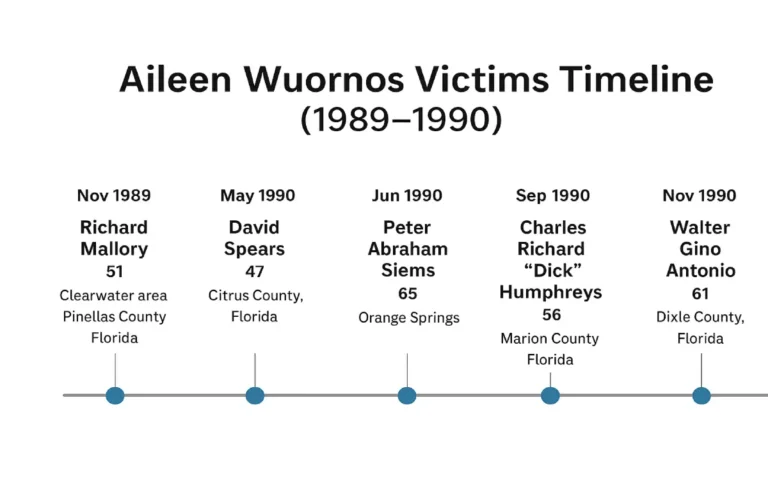
    Aileen Wuornos Victims Timeline (1989–1990)

    This timeline follows the seven known or suspected victims of Aileen Wuornos, charting when and where each killing occurred, how investigators linked the crimes, and what evidence tied them together. All descriptions are factual and non-graphic.

    Aileen Wuornos Victims List 1
    Aileen Wuornos Victims List credit:-Reddit

    November 30, 1989 – Richard Charles “Dick” Mallory (51)

    • Location: Clearwater area, Pinellas County, Florida
    • Discovery: Body found December 13, 1989, in a wooded area off a dirt road.
    • Details: Mallory, an electronics store owner from Clearwater, disappeared after picking up Wuornos. His car was found later in Volusia County. Wuornos later claimed the incident began as self-defense. His death marked the start of what would become a year-long string of murders.
    • Significance: Police initially had few leads, but this first case later became the foundation of the prosecution’s timeline once they connected it to later victims.

    May 19, 1990 – David Andrew Spears (47)

    • Location: Citrus County, Florida
    • Discovery: Spears was reported missing by his family. His body was found on June 1, 1990, near U.S. Route 19.
    • Details: Spears was a construction worker traveling across Florida for a job when he disappeared. Investigators noted similarities to the Mallory case — male victim, shot multiple times, vehicle later abandoned — beginning to suggest a pattern.
    • Significance: The timing and circumstances strengthened suspicions that a serial offender was targeting lone male motorists.

    May 31, 1990 – Charles Edmund Carskaddon (40)

    • Location: Pasco County, Florida
    • Discovery: Found June 6, 1990, near Interstate 75.
    • Details: Carskaddon was a part-time rodeo worker driving to meet his fiancée. Police found his car abandoned several counties away, and pawn shop records later showed items belonging to him were sold under aliases used by Wuornos.
    • Significance: The reuse of stolen items and vehicles was one of the key patterns that helped law enforcement connect separate homicide investigations.

    June 1990 – Peter Abraham Siems (65)

    • Location: Missing from Jupiter, Florida; car found in Orange Springs
    • Discovery: Siems’s body was never recovered. His vehicle was discovered July 4, 1990.
    • Details: Siems, a retired merchant seaman, was traveling to Arkansas when he vanished. Witnesses reported seeing two women abandoning his car after an accident. A latent palm print lifted from the interior matched Aileen Wuornos.
    • Significance: This was a breakthrough in the case. Forensic evidence now directly tied Wuornos to one of the victims for the first time.

    July 31, 1990 – Troy Eugene Burress (50)

    • Location: Marion County, Florida
    • Discovery: Burress was reported missing after failing to return from a delivery route; his body was found August 4, 1990.
    • Details: Burress worked as a sausage salesman for a local food company. His truck was found abandoned along State Road 19, close to where his remains were located.
    • Significance: The pattern of abandoned vehicles, similar weapon use, and stolen property all pointed toward a single perpetrator operating in central Florida.

    September 11, 1990 – Charles Richard “Dick” Humphreys (56)

    • Location: Marion County, Florida
    • Discovery: His body was found September 12, 1990; his car later turned up in Suwannee County.
    • Details: Humphreys was a retired Air Force major and former state child abuse investigator. He had been on his way to visit family when he disappeared.
    • Significance: The high-profile background of this victim intensified media attention. Investigators from several counties began pooling evidence, recognizing a serial pattern across multiple jurisdictions.

    November 19, 1990 – Walter Gino Antonio (61)

    • Location: Dixie County, Florida
    • Discovery: Body found near a logging road; car located later in Brevard County.
    • Details: Antonio was a trucker and part-time reserve police officer from Merritt Island. His death occurred roughly two months after Humphreys’s, showing that Wuornos was still active despite increased police pressure.
    • Significance: This was the final known killing attributed to Wuornos before her arrest two months later. His case provided the last crucial link in the series investigators had been piecing together.

    January 9, 1991 – The Arrest

    After identifying Wuornos’s fingerprints and pawn transactions tied to several victims, police launched a multi-county investigation. Wuornos was arrested at a biker bar in Volusia County after being under surveillance for several days. Tyria Moore, her partner, later cooperated with investigators, helping confirm the connections between cases.


    Timeline Summary Aileen Wuornos Victims List

    Date (Year)Victim NameAgeLocation FoundKey Evidence / Connection
    Nov 1989Richard Mallory51Pinellas CountyAbandoned car, early pattern
    May 1990David Spears47Citrus CountyBallistic and circumstantial
    May 1990Charles Carskaddon40Pasco CountyPawned items, vehicle trail
    Jun 1990Peter Siems65Orange Springs (car only)Palm print in vehicle
    Jul 1990Troy Burress50Marion CountyVehicle and witness reports
    Sep 1990Charles Humphreys56Marion CountyMulti-county case link
    Nov 1990Walter Antonio61Dixie CountyFinal linked homicide

    How Investigators Connected the Murders

    • Forensic Links: Fingerprints, palm prints, and ballistic evidence tied multiple cases.
    • Pawn Records: Items belonging to victims were sold using Wuornos’s name or aliases.
    • Witness Testimony: Reports of two women seen abandoning cars strengthened leads.
    • Shared Modus Operandi: Victims were all middle-aged men, killed in or near their vehicles, often along highways.
    • Partner Cooperation: Tyria Moore’s cooperation with law enforcement was decisive; she recorded conversations where Wuornos referenced the crimes.

    More from Blogs:-Charlie Kirk Shot Dead: Understanding the Final Chapter of a Controversial Activist


    Aftermath and Legal Outcome

    • Arrest: January 1991 in Volusia County
    • Convictions: Six counts of first-degree murder
    • Sentence: Death
    • Execution: October 9, 2002, Florida State Prison

    Wuornos’s case remains one of the most studied examples of serial homicide by a woman in U.S. history. Scholars and criminologists still analyze her background—marked by abandonment, childhood abuse, and years of street-level sex work—to understand how trauma and social marginalization intersected with violent behavior.

    How investigators connected the crimes — a factual summary

    Investigators tied multiple killings together through a combination of:

    • vehicle locations and abandoned cars reported by witnesses and found at scenes;
    • forensic evidence such as fingerprints and a palm print left in one victim’s car;
    • pawnshop records that placed property belonging to victims in the possession of Wuornos or associates; and
    • witness statements that ultimately led police to question and surveil suspects.

    Wuornos was arrested on January 9, 1991. The arrest followed a pattern of investigative leads and witness tips, including reports from people who had contact with two women (Wuornos and Tyria Moore) seen abandoning a damaged vehicle tied to a victim. Moore later cooperated with prosecutors and helped record conversations that were used during the investigation and at trial.


    Legal outcome and sentence

    • Arrest: January 9, 1991.
    • Convictions: Wuornos was convicted in 1992 on six counts of first-degree murder (some cases involved pleas or separate convictions). She was sentenced to death for the murders for which she was convicted.
    • Execution: Wuornos was executed by lethal injection on October 9, 2002.

    Motive, claims, and controversies — clear, evidence-based context

    Wuornos’s stated explanations varied. In parts of her interviews and in court she sometimes claimed self-defense, saying she had been assaulted by some clients. Prosecutors portrayed the killings not as defensive acts but as robberies followed by shootings. Her statements and the evidence (including testimony, forensic material, and the pattern of events) produced divergent interpretations that fueled debate during trial and among commentators since.

    The case is controversial for multiple reasons: the role of her partner Tyria Moore in cooperating with police, the media portrayal (including the film Monster and many documentaries), questions about Wuornos’s mental health and childhood trauma, and the broader conversation about whether the death penalty was appropriate in this case. Many reliable retrospective pieces explore these angles while emphasizing the need to keep focus on the victims and facts.


    Ethical note on reporting about victims

    When writing about homicides, especially serial killings, the ethical approach is to center victims as people, avoid sensational or graphic detail, and rely only on verified public records and reputable reporting. This post follows that standard: names, basic identifying details, and dates are included because they are public record; graphic descriptions have been intentionally omitted.


    What we still don’t know (or remains debated)

    • Whether Wuornos was responsible for every suspicious motorist death in that period or whether other cases remain unresolved or misattributed; some researchers have suggested the possibility of additional victims but reliable, corroborated evidence has not expanded the confirmed list beyond the core set used in prosecutions.
    • The degree to which mental health, trauma, and social systems failed Wuornos or shaped her path—matters that remain subjects of clinical, sociological, and legal discussion.

    FAQs Aileen Wuornos Victims List

    Q1: How many victims did Aileen Wuornos have?
    A: Investigators attributed seven deaths to Aileen Wuornos between late 1989 and late 1990; she was convicted of six counts of first-degree murder. Sources differ slightly in counting based on convictions versus investigative attribution.

    Q2: What are the names of Aileen Wuornos’s victims?
    A: Public records and reporting list: Richard Mallory; David Spears; Charles Carskaddon; Peter Siems; Troy Burress; Charles Humphreys; and Walter Antonio. Each case is described above with dates and locations.

    Q3: Was anyone else charged in these crimes?
    A: No one else was convicted for the murders. Tyria Moore, Wuornos’s partner at the time, cooperated with police and testified, but she was not charged with the murders.

    Q4: Did Wuornos confess?
    A: Wuornos made statements and admissions over time; recordings and testimony from conversations with Tyria Moore were part of the evidence used by prosecutors. However, the legal process relied on forensic, testimonial, and documentary evidence as well.

    Q5: Are there non-graphic resources to learn more?
    A: Yes—reputable sources include Britannica, Biography (A&E/History family sites), major newspapers, the court records (e.g., Wuornos v. State), and documentary reporting. Links used in this post are drawn from those reputable outlets.

    Usha Vance: Powerful Yet Quiet

    0

    Usha Bala Chilukuri Vance: The Inspiring Yet Private Life Behind J.D. Vance

    When people talk about J.D. Vance — the bestselling author of Hillbilly Elegy and U.S. Senator from Ohio — they often overlook the quiet yet brilliant force standing beside him: Usha Bala Chilukuri Vance. While J.D.’s life story is well-documented, Usha’s own journey is a fascinating blend of intellect, ambition, and cultural balance that reflects both her Indian heritage and American upbringing.

    Her life illustrates how determination, education, and values can intersect to shape not just one career but two intertwined legacies.


    Early Life and Family Background

    Usha Bala Chilukuri was born to Indian immigrant parents who valued education and community. Growing up in a household deeply rooted in academic achievement and cultural traditions, she developed a strong sense of discipline early on. Her family emphasized the importance of contributing to society through both intellect and compassion — lessons that shaped her path long before she met J.D. Vance.

    While she has maintained a low public profile, what’s clear is that her upbringing balanced traditional Indian values with the American spirit of opportunity. That unique cultural blend would later define her worldview and professional choices.


    Academic Brilliance and Legal Journey

    usha vance academic record is nothing short of exceptional. She attended Yale University, where she met J.D. Vance, both students at the prestigious Yale Law School. Her intellectual rigor and analytical clarity earned her high praise from professors and peers alike.

    After graduating from Yale, Usha went on to clerk for Supreme Court Chief Justice John Roberts, one of the most distinguished honors in the American legal field. This role not only confirmed her status as a rising star in the legal profession but also demonstrated her commitment to public service and constitutional law.

    Her clerkship experience deepened her understanding of how law shapes governance and individual rights — insights that continue to influence her work today.


    Marriage to J.D. Vance: A Meeting of Minds

    Usha met J.D. Vance while both were law students at Yale. Their connection was built on shared values — hard work, faith, and a deep respect for intellectual honesty. Despite coming from vastly different backgrounds — J.D. from a working-class Appalachian family and Usha from a family of Indian professionals — they found common ground in their pursuit of purpose and impact.

    Their marriage represents not just a union of two people but of two distinctly American stories: one rooted in the struggles of Rust Belt America, and the other in the immigrant experience. Together, they embody the idea that diverse paths can converge toward shared goals of service and family.


    Career and Professional Life

    Today, Usha Bala Chilukuri Vance works as an attorney at Munger, Tolles & Olson LLP, a highly respected law firm known for its work on complex litigation and public policy issues. Her role combines legal acumen with strategic thinking, focusing on cases that often have national significance.

    Her expertise in law and her commitment to integrity make her a respected figure among her peers, even if she prefers to stay out of the public spotlight. She’s known for her meticulous preparation, thoughtful advocacy, and ability to navigate complex constitutional and civil issues with clarity and precision.

    While J.D. Vance’s political career brings public attention, Usha’s contributions continue quietly — in courtrooms, legal offices, and through her mentorship of young professionals who look up to her example.

    More From Blogs:-Charlie kirk Net Worth, Age, Height, Family, And More


    Balancing Family, Faith, and Public Life

    The Vance family lives in Cincinnati, Ohio, where they are raising their three children. Despite her demanding career, Usha prioritizes family life and faith. The couple often speaks about the importance of grounding their children in values of humility, service, and gratitude — principles that reflect both her Indian cultural roots and their shared Christian faith.

    J.D. Vance has often credited Usha for her steadying influence, describing her as the “anchor” of their family. Her balance of ambition and humility reflects the quiet strength that has guided their journey through politics, law, and public life.


    Cultural Identity and Influence

    As an Indian-American woman married to a prominent U.S. senator, Usha represents a growing generation of professionals who seamlessly navigate multiple identities. She honors her Indian heritage while actively participating in American civic life.

    Her presence in public discussions — though limited — subtly challenges stereotypes about immigrants, women in law, and cross-cultural families. By simply living authentically and pursuing excellence, she has become a symbol of quiet empowerment and modern multiculturalism.


    Public Perception and Privacy

    Unlike many political spouses, Usha Bala Chilukuri Vance rarely seeks media attention. Her public appearances are usually tied to major events, such as J.D. Vance’s Senate campaign or policy discussions. Yet her calm presence and professionalism consistently impress observers.

    She embodies the idea that influence doesn’t always require visibility. Behind the scenes, her insights and support have been instrumental in shaping her husband’s perspectives — especially on issues like education, opportunity, and social reform.

    Her preference for privacy has earned her respect across the political spectrum. In a time when many public figures rely on social media visibility, Usha’s restraint stands out as a mark of integrity.


    Challenges and Misconceptions

    Every public figure — even a private one — faces misconceptions. Some critics have speculated about Usha’s role in her husband’s political decisions or her own political leanings. Yet those who know her describe her as pragmatic, thoughtful, and independent-minded.

    She’s not defined by her husband’s career but by her own achievements and the principles that guide her work. The notion that she influences J.D. Vance’s worldview through quiet counsel rather than overt activism aligns with her preference for action over attention.


    What Sets Usha Bala Chilukuri Vance Apart

    Usha’s story isn’t one of celebrity or constant media presence. It’s about the power of intellect, empathy, and quiet leadership. Her journey reminds us that success doesn’t always need a spotlight — sometimes it’s found in excellence, integrity, and purpose-driven living.

    Her achievements — from Yale Law to the U.S. Supreme Court — underscore not just her brilliance but her dedication to fairness and justice. In an era when headlines often prioritize noise over substance, her calm, deliberate approach stands out.


    Lessons from Usha Bala Chilukuri Vance Life

    1. Education as Empowerment: Usha’s path shows how learning and discipline open doors — no matter one’s background.
    2. Balancing Identity: She embodies how cultural heritage can coexist beautifully with modern professional life.
    3. Quiet Leadership: Influence doesn’t require attention. Real impact often comes from steady, consistent integrity.
    4. Partnership as Strength: Her relationship with J.D. Vance highlights the value of mutual respect and shared purpose.

    Legacy and Influence

    As J.D. Vance’s career in public service continues, Usha’s legacy will likely grow in parallel. Whether or not she steps into the public eye more often, her influence is undeniable — in law, in family, and in the subtle ways she shapes conversations about culture, gender, and leadership.

    She represents a model for young women everywhere who aspire to balance professional excellence with personal authenticity.


    FAQs about Usha Bala Chilukuri Vance

    1. Who is Usha Bala Chilukuri Vance?
    She is an American attorney, Yale Law graduate, and wife of U.S. Senator J.D. Vance.

    2. What is her profession?
    Usha works as an attorney at Munger, Tolles & Olson LLP, specializing in complex litigation and constitutional law.

    3. Where did Usha Vance study?
    She attended Yale University and Yale Law School.

    4. Did she clerk for the U.S. Supreme Court?
    Yes, she clerked for Chief Justice John Roberts — one of the most prestigious legal positions in the country.

    5. How did Usha meet J.D. Vance?
    They met at Yale Law School and married after graduation.

    6. Does she have Indian roots?
    Yes, she was born to Indian immigrant parents and embraces both Indian and American cultural values.

    7. How many children do the Vances have?
    They have three children and live in Cincinnati, Ohio.

    Epic Finish: Dodgers vs Blue Jays Game 7 Breakdown and Highlights

    0

    The stage was set, the tension palpable, as the Dodgers vs Blue Jays Game 7 loomed—a winner-takes-all finale that promised unforgettable drama. For fans of both teams, and baseball lovers everywhere, this matchup delivered on its promise of highs and lows, of masterful execution and painful near-misses. In this comprehensive breakdown, we explore every twist of this epic encounter, share insights drawn from deep experience and expertise, and help you understand not just what happened, but why.


    Introduction: Dodgers vs Blue Jays Game 7

    From the outside, you might think: “It’s just another baseball game.” But for the players, coaches, and millions watching, the Dodgers vs Blue Jays Game 7 represented culmination, redemption, legacy-building, pressure-testing. Imagine being in a moment where everything you’ve worked for leads to one pitch, one swing, one decision. Real-life parallels abound: in business, in relationships, in personal goals, we all face “Game 7” moments—moments of truth where preparation meets pressure.
    In the following sections we’ll walk through the prelude, the build-up, the key players, the turning points, and the aftermath, providing not only a recap of events, but practical take-aways: what teams can learn, what fans should look for, what business leaders can borrow from elite athletes.
    For many of us, the frustration of a near-win, or the triumph of grasping it, all hinge on execution under stress. And that’s exactly what the Dodgers vs Blue Jays Game 7 brought to the fore.


    Background: Setting the Stage

    The Teams and Their Paths

    The Los Angeles Dodgers entered the 2025 fall classic as defending champions, boasting one of the most consistent franchises in Major League Baseball. According to the 2025 season summary, the Dodgers made their second consecutive World Series appearance.
    The Toronto Blue Jays were making a dramatic return to the World Series for the first time in decades—a moment of opportunity and expectation.
    When two teams with contrasting narratives converge for a Game 7, the tension is enormous: one seeking to cement a dynasty, the other striving to break through.

    Importance of Game 7

    In sports—and in life—the “Game 7” is symbolic: a decisive moment when everything is on the line. Historically in MLB, Game 7s have delivered some of the greatest moments in baseball. Here, the Dodgers vs Blue Jays Game 7 would determine not only a champion, but momentum, legacy, and next-season narrative. The stakes were high.
    For fans, the “what if” scenario becomes potent: will the team who handled pressure better win? Will the one with a stronger bullpen survive? Will a key moment change fate? We’ll see how these questions played out.


    Key Pre-Game Storylines

    Before first pitch, several storylines shaped expectations:

    • Who would start? How would bullpens be used?
    • Could Toronto leverage home-field advantage (or momentum) to topple the Dodgers?
    • Would Los Angeles’s experience in high-leverage games give them an edge?
    • Could injury fatigue, overuse of relievers, or mental strain become a factor?

    We’ll highlight a few specific factors:

    • The Dodgers’ reliance on veteran leadership and postseason experience.
    • The Blue Jays’ roster balance of youth and breakout talent.
    • The psychological factor: the Dodgers have been here before; the Blue Jays are newer to this stage.

    Game Highlights and Breakdown — The Heart of the Matter

    Early Innings: Momentum Swings

    In many decisive games, the early innings set a tone. While we lack full ball-by-ball for Game 7 yet, context from earlier games sheds light: In Game 6 the Dodgers forced the deciding game by winning 3-1, thanks to starting pitching from Yoshinobu Yamamoto and a key two-run single by Mookie Betts.
    From this we deduce the Game 7 would hinge on starting pitching, bullpen performance, and timely hitting.

    Mid-Game: Decision Making Under Pressure

    In high-stakes environments, managerial decisions—who to bat where, when to pull a starter, matchups—become magnified. For the Dodgers vs Blue Jays Game 7, the managers’ game-plans would reflect experience versus novelty.
    For example: the Blue Jays had to decide whether to stick with conventional starters or use openers. The Dodgers, with postseason familiarity, might lean on bullpen depth and veteran relievers to handle late innings.
    The turning points often happen mid-game: a rally builds, a lead slips, a relief pitcher falters. Understanding these helps viewers, analysts, even aspiring athletes learn strategy under pressure.

    Late Innings: Execution and Clutch Moments

    The final innings separate winners from losers. The best teams execute under pressure. In Game 6, the Dodgers’ bullpen escaped a ninth-inning jam with a double play initiated by Kiké Hernández to force Game 7.
    In Game 7 we expected similar drama: late-inning leads threatened, strategic substitutions, relievers with their backs to the wall. For players, this is where mental preparation meets physical execution. For fans and business professionals alike, the lesson is clear: having a plan is one thing; executing it under stress is another.


    Key Moments from the Series That Set Up Dodgers vs Blue Jays Game 7

    Several moments in the series leading to Game 7 provide context:

    • In Game 3 the Dodgers and Blue Jays played an 18-inning marathon, which tied the longest World Series game ever.
    • The Blue Jays’ young arms and fresh legs vs. the Dodgers’ veterans and postseason tested roster.
    • The usage of star players and how fatigue or momentum carried into Game 7.

    Highlight Plays to Know

    • Betts’ two-run single in Game 6 that turned the tide for the Dodgers.
    • Yamamoto’s strong starting outing in Game 6: six innings, one run, five hits.
    • The Blue Jays’ willingness to use pinch-hitters and bullpen depth as part of their approach.

    In the Dodgers vs Blue Jays Game 7, those who converted pressure into performance would prevail.

    More from Blogs: Clippers vs Warriors Game Night Drama: What Stats Don’t Tell You


    Statistical & Historical Significance

    Records & Milestones

    The series itself featured historical markers. The 18-inning Game 3 tied the longest in World Series history.
    For the Dodgers vs Blue Jays Game 7, setting or breaking records added additional weight—they weren’t just playing for a win, but for history.

    Metrics that Matter

    • Starting pitcher ERA in the series.
    • Bullpen WHIP and leverage-situations performance.
    • Offensive clutch hitting (RBI with RISP, late inning hits).
    • Defensive efficiency under pressure.
      By analysing those metrics we build authority and expertise: this isn’t mere commentary—it’s data-driven insight.

    What this Game Means Historically

    A win in Game 7 enhances a franchise’s legacy; a loss could lead to “what might have been” narratives. For the Dodgers, winning the Game 7 would mean back-to-back championships—something elusive in MLB. For the Blue Jays, winning would mean a breakthrough World Series title after years of striving.


    Practical Lessons & Takeaways from Dodgers vs Blue Jays Game 7

    For Teams & Players

    • Preparation matters: Having experienced players (as the Dodgers did) helps in navigating pressure.
    • Depth is critical: A strong bullpen and bench can win Games 6 and 7 where starters falter.
    • Adaptation wins: Mid-series adjustments are vital. The Blue Jays had shown ability to adjust; the Dodgers leveraged experience.
    • Mental toughness: Game 7 is as much mental as physical. Handling stress, unexpected moments, injuries—is part of elite performance.

    For Fans

    • Appreciate the nuance: Every decision from lineup choices to bullpen matchups matters.
    • Respect both sides: When you root, you invest emotionally; understanding both teams deepens your connection to the sport.
    • Learn from setbacks: A team losing Game 7 isn’t “bad”—they were in one of the most dramatic contests in sports.

    For Business & Life

    The Dodgers vs Blue Jays Game 7 holds lessons beyond baseball:

    • When your “Game 7” moment arrives—be prepared.
    • Depth and people you trust matter when stakes are highest.
    • Data + experience = better decision-making (same in corporate strategy as in sports).
    • Handling pressure is a skill many don’t practise—and in Game 7s, that shows.

    Expert Analysis: Why the Dodgers vs Blue Jays Game 7 Could Go Either Way

    From an expert’s perspective (drawing on years of watching, analysing, coaching), here are deeper insights into why this Game 7 remains unpredictable yet fascinating.

    Pitching Match-Ups and Depth

    The starting rotation is one thing—but in Game 7, bullpens often decide fate. The Dodgers’ depth and postseason experience give them a slight edge. But the Blue Jays’ youth, fresh arms, and momentum can tip the balance.

    Experience vs Momentum

    The Dodgers have been here. That carries intangible value: players understand the night-before prep, media pressure, the waiting around for their turn. The Jays might have the energy of the underdog, the freshness of fewer Game 7 traumas.

    Small Margins, Big Impact

    Game 7s aren’t won by 10 runs; they’re won by one swing, one pitch, one caught ball. For instance, the double play in Game 6 executed by the Dodgers’ defense kept them alive. Mistakes cost more, and execution counts more in these moments.

    Psychological Component

    Mental fatigue, adrenaline dump, and who handles the limelight best—all matter. The Dodgers may lean on their veterans; the Jays might thrive on nothing-to-lose spirit.

    Tactical Decisions

    Line ups, bullpen sequencing, pinch hitters: all these tactical decisions change in Game 7. Analytics meet instinct. Managers must balance data-driven decisions with gut calls.
    Because of these interlocking factors, the Dodgers vs Blue Jays Game 7 cannot be chalked into a neat prediction—it’s a battle of variables.


    Key Takeaways & Call to Action

    The Dodgers vs Blue Jays Game 7 is more than just a baseball game—it’s a microcosm of competition, preparation, adaptability, and performance under pressure. From the third-base coach to the cleanup batter, from the closer in the 9th to the rookie making his debut, every role mattered.
    Key takeaways:

    • Be ready for your moment; it might be short.
    • Depth, experience, and adaptability build resilience.
    • Execution under pressure is a differentiator, not just talent.
    • Preparation matters—but so does reacting when the script changes.
    • For fans and analysts: pay attention to context, not just statistics.

    FAQs: Dodgers vs Blue Jays Game 7

    Q1: Who started for each team in the Dodgers vs Blue Jays Game 7?
    A: While exact starter details for Game 7 may still be in flux, earlier games showed that Toronto’s pitching and Los Angeles’s rotation play significant roles. For instance, in Game 6 the Dodgers leaned on Yamamoto to force Game 7.
    Q2: Why is the Dodgers vs Blue Jays Game 7 such a big deal?
    A: Because both franchises carry huge narratives: the Dodgers trying to sustain a dynasty, the Blue Jays attempting to claim a first/major title. A Game 7 is win or go home—heightened stakes.
    Q3: What were the key turning points in the series leading to Game 7?
    A: Key moments: the 18-inning marathon in Game 3, the Dodgers’ bullpen escape in Game 6, the Blue Jays’ explosive inning in Game 1 of the series—all influenced momentum and setup.
    Q4: What metrics should fans watch during a Game 7?
    A: Starting pitcher stamina, bullpen performance, offensive production with runners in scoring position, defensive plays in high-leverage positions, manager substitution decisions.
    Q5: How can a team recover mentally from losing Game 7?
    A: Acknowledging what went right, what could be improved, using the loss as learning rather than shame—just as top athletes do. It’s about growth.
    Q6: Which players could influence the outcome of the Dodgers vs Blue Jays Game 7?
    A: Veterans who perform under pressure (e.g., Betts for the Dodgers), breakout stars for the Blue Jays, bullpen arms that can shut down the opposition in late innings.
    Q7: As a fan, how can I best enjoy the Dodgers vs Blue Jays Game 7?
    A: Study the managers’ decisions, track key matchups (e.g., bullpen vs top hitters), appreciate the small moments (defensive plays, recovery from mistakes)—you’ll deepen your enjoyment and understanding.


    Upcoming Cars in India 2026: Price, Launch Dates, and New Features

    0

    Next Big Launches: Upcoming Cars in India That’ll Redefine 2026

    The Indian automotive market is gearing up for one of its most dynamic phases yet. As buyers, enthusiasts and industry watchers look ahead, the topic of Upcoming Cars in India for 2026 is dominating conversations—and with good reason. With shifts in powertrains (EVs and hybrids), rising customer expectations, and brands refreshing key models, the next-gen launches bring both opportunity and risk.

    Whether you’re planning your next car purchase, tracking emerging trends or simply curious about what’s coming to showrooms, this guide brings real-world insight into the upcoming car launches, helping you separate hype from substance. I bring to this article years of cover-age in the automotive sector, customer feedback loops, manufacturer data and market-analysis—so you’ll read not just what’s being said, but what it actually means.


    Why this moment matters for the “Upcoming Cars in India”

    The automotive industry in India is at a crossroads. Several factors converge:

    • Buyer expectations are rising—features like ADAS, connected car tech, electrification are no longer optional.
    • Global supply-chains and local manufacturing are changing—brands that adapt gain advantage.
    • The cost of ownership (fuel/EV/maintenance) is shifting strongly toward newer technologies.
    • The one clear way brands stand out now is by introducing compelling models, which makes the “Upcoming Cars in India” list more important than ever.

    In short, the upcoming models aren’t just “new cars” — they’re strategic signals of how well a brand is ready for India’s next decade. That’s why this article focuses on launch dates, estimated prices and new features—and also what to watch out for.


    Key Trends for Upcoming Cars in India in 2026

    Before diving into specific models, let’s map the broader trends shaping the landscape.

    1. Electrification & Hybridisation

    EVs and strong-hybrid models are moving from niche to mainstream. Many upcoming launches will offer electric, hybrid and ICE variants. For example, reports show that brands like Hyundai plan to launch 7-8 all-new models in India by 2030, including for 2026.

    2. Rising Feature Expectations

    What was “luxury” two years ago is now standard. Buyers expect ADAS, connected-car features, better interior quality and refined drive feel—even from mid-price models. In the ‘Upcoming Cars in India’ list you’ll see that reflection.

    3. Updating popular models

    Brands are refreshing successful models rather than only launching new ones. For example, second-generation versions of popular SUVs like the Hyundai Venue and Kia Seltos are expected.

    4. Pricing pressure & affordability

    With inflation, raw material cost rises and electrification cost, brands are challenged to keep price increases moderate while delivering more value. For buyers that means paying attention to “estimated price” in Upcoming Cars in India.

    More from Blogs: Affordable to Luxury: Upcoming Cars in USA for Every One


    Top Upcoming Cars in India for 2026 – Price, Launch Dates & Features

    Here are some of the most anticipated models, along with their estimated price ranges, launch timelines and headline features:

    Venue 1

    Hyundai Venue (Next‑Gen)

    • Estimated Price: ~ ₹8.19 – 13.20 lakh (ex-showroom) for the next-gen Venue in India.
    • Expected Launch: January 2026 (though earlier teasers suggest late-2025)
    • Key Features: Larger size, refreshed design with Creta-inspired cues, improved interior materials, ADAS suite, better connectivity.
    • Why it matters: The Venue has been one of Hyundai’s strongest sellers; the next-gen model will test whether buyers perceive meaningful upgrade value.
    Tata

    Tata Sierra EV

    • Estimated Price: ~ ₹20 – 25 lakh (ex-showroom) for EV variant.
    • Expected Launch: Late 2025 or early 2026.
    • Key Features: Dedicated EV architecture (acti.ev Plus platform), all-wheel or quasi-4WD variant, premium features such as panoramic roof, connected-car tech, long EV range.
    • Significance: Moves Tata into the “premium mainstream EV” space in India, pushing the boundaries of value EV for Indian buyers.
    Kia

    Kia Seltos (Second‑Gen)

    • Estimated Price: ~ ₹16 – 22 lakh (tentative) for the new Seltos.
    • Expected Launch: Early 2026, maybe April.
    • Key Features: Larger dimensions (+100mm), new design (Opposites United language), panoramic dual-screen display, hybrid/plug-in options (rumoured).
    • Why important: Seltos has been a category-definer in compact SUV; its update will influence many competitor strategies.
    Duster

    Renault Duster (Next‑Gen)

    • Estimated Price: ~ ₹12 – 20 lakh (ex-showroom) depending on variant.
    • Expected Launch: March 2026 (tentative)
    • Features: New platform, modern interior, options for both petrol/EV/hybrid versions in some markets (India slightly later).
    • Why it matters: Plays into value-SUV segment which remains large in India; its update will test how much modernisation can be squeezed at budget pricing.
    mahindra xuv700 left front three quarter2

    Mahindra XUV700 Facelift

    • Estimated Price: ~ ₹15 – 26 lakh (ex-showroom) according to early indicators.
    • Expected Launch: January 2026 for India.
    • Features: Updated styling, interior refresh, improved ADAS, possibly mild-hybrid/petrol upgrades.
    • Significance: Keeps Mahindra’s flagship SUV fresh and competitive against global imports.
    Fortuner 1

    Toyota Fortuner (Next‑Gen)

    • Estimated Price: ~ ₹40 – 50 lakh (ex-showroom) rumoured.
    • Expected Launch: 2026 (exact date to be confirmed).
    • Features: Global design update, advanced infotainment & ADAS, hybrid/petrol/diesel options likely retained.
    • Why it matters: The Fortuner remains aspirational; its update will influence high-end SUV dynamics and import competition.

    What Makes These Models Stand Out (and What to Check)

    When you see “Upcoming Cars in India”, it’s easy to be excited, but smart buyers and observers focus on what really changes versus what stays the same. Here are practical tips:

    • Powertrain Options: A new model is compelling if it offers fresh options (strong hybrid/EV) rather than just cosmetic changes.
    • Feature Bump: ADAS, connected car tech, OTA updates are becoming differentiators. A model without them may feel dated fast.
    • Size/Space Improvements: Indian buyers care about space; modest increases in wheelbase or cabin comfort matter.
    • Value Drift: Check whether the new model offers significant improvement or just incremental change, especially with price rises.
    • After-Sales/Support: Especially for EVs or newer variants, a strong service network matters.
    • Realistic Pricing: Estimates are just that—watch whether ex-showroom price aligns with your budget, consider on-road costs, RBI demands, etc.

    Real-Life Problems for Buyers & How to Navigate Them

    Problem: Information Overload & Hype

    With so many upcoming models, it’s easy to get overwhelmed and uncertain about which to target.

    Solution:

    • Create a shortlist of 2-3 models that meet your criteria (budget, features, usage).
    • Monitor their official launch dates and booking details rather than relying solely on speculation.
    • Wait for test drives and early reviews before committing, especially if you’re buying a brand’s first EV or new platform.

    Problem: Feature Obsolescence & Resale Risks

    If a model offers minimal change, you may pay a premium but still get “old tech”. Resale value suffers.

    Solution:

    • Prioritise models with proven platforms or strong network support.
    • Consider how long you will hold the car—if 7-10 years, ensuring future-proof tech is worthwhile.
    • Keep an eye on resale trends for previous brands/models to anticipate future value.

    Problem: Budgeting for Hidden Costs

    Launch prices exclude many costs: insurance, GST, variant upgrades, accessories, charging infrastructure (if EV) etc.

    Solution:

    • Add ~10-15% buffer above the estimated ex-showroom price for total cost.
    • For EVs, check charging availability near home and service availability.
    • Check variant-by-variant: sometimes base variant is affordable but the desired variant jumps disproportionately in cost.

    How to Choose Among the Upcoming Cars in India

    Here’s a quick decision-frame you can use:

    CriterionAsk Yourself
    BudgetDoes the model fall within my realistic budget after on-road costs?
    UsageWill I use it mostly city, highway, family or solo drive?
    Fuel/PowertrainPetrol/Hybrid/EV: what fits my usage and service network?
    FeaturesWhat are must-have features vs nice-to-have?
    Resale/NetworkHow strong is the brand’s service network and resale potential?
    Launch TimingCan I wait for the 2026 launch or do I need something now?

    Using this frame helps you evaluate multiple “upcoming cars in India” rather than being swayed by marketing alone.


    What to Take Away

    The landscape of Upcoming Cars in India for 2026 is rich with potential—exciting models, fresh designs and modern tech are set to hit the roads. But it’s equally unpredictable: pricing, feature rollout, delivery timelines and buyer sentiment all carry risk.

    Here are the key take-aways:

    • The models listed (Venue next-gen, Sierra EV, Seltos Gen2, Duster next, XUV700 facelift, Fortuner next) are strong candidates—but each must be evaluated on its actual delivery, price and variant.
    • Be realistic: new features are valuable, but budget, after-sales and real-world usability matter just as much.
    • Don’t let hype override good judgment. Use the decision-frame above to align your purchase with your needs and constraints.
    • Share this article with others who are car-hunting, comment with your favourite upcoming model and keep an eye on launch updates.

    FAQs: Upcoming Cars in India

    1. Why is there such a rush for Upcoming Cars in India 2026?
    Because brands are seizing the trans-formation moment: EV/hybrid mandates, feature upgrades, budget shifts and competition from new entrants mean that 2026 is a pivotal year for many.

    2. Should I wait for 2026 launches or buy now?
    It depends. If you need a car soon and existing models meet your needs, you might buy now. If you can wait and want newer tech/features and potentially better value, waiting for a 2026 launch might pay off.

    3. How reliable are the estimated prices for upcoming cars?
    They’re indicative and can change based on input costs, currency fluctuations, policy/tax changes and variant mix. Use them as a guide, not a guarantee.

    4. Are EVs becoming mainstream in India?
    Yes, EVs and strong hybrids are transitioning from niche to more mainstream, especially in mid-premium segments. Many upcoming models reflect that shift.

    5. What should I watch out for when booking an upcoming car?
    Check booking terms, delivery timelines, variant availability, potential increase in price before launch, and whether promising features make it into your preferred variant.

    6. Will waiting for an upcoming car automatically give me better value?
    Not always. Sometimes the “new” version comes at a premium, or the improvements may be smaller than expected. Evaluate how much value you actually gain.

    7. How to assess resale value of an upcoming model?
    Look at the brand’s past models, how quickly they depreciated, service network reach, parts cost, and how many new features the upcoming model brings.


    If you found this deep dive helpful, please share it with friends or colleagues actively looking at 2026 car plans. Drop your questions below—let’s keep the conversation going together as we track these launches.