More
    Home Blog Page 37

    GST Slabs 2.0 in India 2025: Effect on Common People

    0

    GST Slabs 2.0 – India has just seen one of the most important tax changes since the Goods and Services Tax (GST) was rolled out in 2017. On September 3, 2025, the GST Council announced a major revamp of the GST slab structure, reducing complexity for millions of businesses and consumers.

    The new framework brings GST Slabs 2.0 down from four slabs to two—5% and 18%—with an additional 40% slab for sin and luxury goods.

    This blog breaks down the new GST slabs 2.0 in India, explains their impact on households and businesses, and prepares you for GST 2.0, set to go live on September 22, 2025.


    What Are the New GST Slabs 2.0 in India 2025?

    Until now, India followed four GST brackets—5%, 12%, 18%, and 28%. The new system simplifies this into:

    • 5% → Essentials and mass consumption goods
    • 18% → Standard goods, services, and durables
    • 40% → Sin and luxury goods

    This means the 12% and 28% slabs have been scrapped, pushing most products into just two simplified categories.


    Key Highlights of the GST Slabs 2.0 Council Meeting

    ✅ 5% GST Slab

    • Essentials, medicines, food items, and affordable clothing

    ✅ 18% GST Slab

    • Consumer durables, electronics, cement, automobiles, and services

    ✅ 40% GST Slab

    • Sin and luxury goods like tobacco, cigarettes, pan masala, gutkha, and luxury cars

    📅 Rollout Date

    • September 22, 2025

    🎯 Objective

    • Simplify GST compliance
    • Boost consumption in essentials and durables
    • Discourage harmful or luxury consumption

    GST Slabs 2.0: Why the New Slabs Were Introduced

    The government’s reasoning behind GST 2.0 is threefold:

    1. Simplification – Businesses struggled with four slabs and frequent disputes over classification. Fewer slabs = smoother compliance.
    2. Boost Spending – Cheaper essentials and durable goods encourage household consumption, pushing economic growth.
    3. Public Health & Revenue – A 40% rate on sin goods both deters unhealthy use and generates extra tax income.

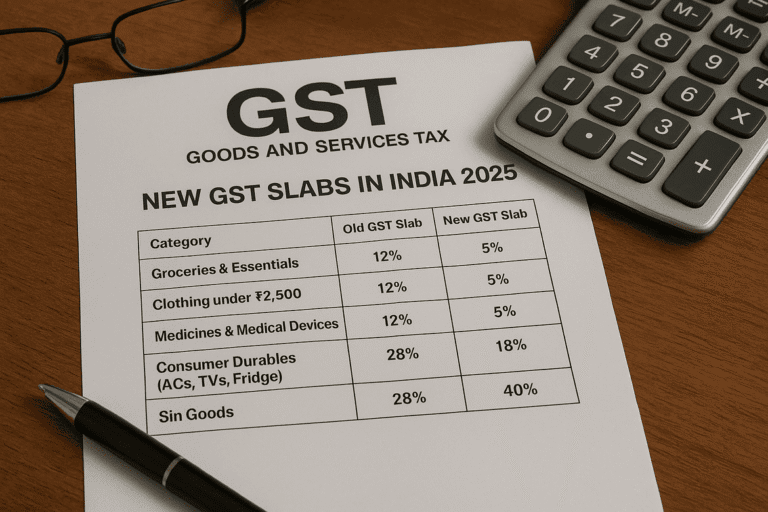
    New GST Slabs 2.0 2025: Comparison Table

    CategoryOld GST SlabNew GST Slab (Effective Sept 22, 2025)
    Groceries & Essentials12%5%
    Clothing under ₹2,50012%5%
    Medicines & Medical Devices12%5%
    Consumer Durables (ACs, TVs, Fridge)28%18%
    Cement & Building Materials28%18%
    Automobiles (standard)28%18%
    Sin Goods (Tobacco, Luxury Cars, Pan Masala)28% + Cess40%

    Impact of New GST Slabs 2.0 on Consumers

    1. Essentials Become Cheaper

    Daily-use products like packaged food, groceries, medicines, and clothing under ₹2,500 now fall under 5%. Relief for middle-class households is significant.

    2. Durable Goods Get Affordable

    Big-ticket items—TVs, fridges, ACs, washing machines—drop from 28% to 18%. Expect festive-season discounts and rising demand in the electronics sector.

    3. Sin Goods Get Costlier

    Luxury SUVs, tobacco, cigarettes, gutkha, and similar goods will now be taxed at 40%, discouraging overconsumption and raising government revenue.


    Impact of New GST Slabs on Businesses

    🔹 MSMEs & Startups

    • Easier classification = fewer compliance headaches
    • Lower costs on essentials bring pricing advantages

    🔹 Manufacturing Sector

    • Automobile and cement industries benefit from lower rates
    • Durable goods makers may see higher festive demand

    🔹 State Revenues

    • Short-term dip of approx. ₹50,000 crore
    • A compensation mechanism is under review for states

    GST 2.0 Rollout: What Businesses Should Do

    1. Reprice Goods & Services – Update billing systems by September 22
    2. Reconfigure ERP/Accounting – Adjust tax mappings to match the new slabs
    3. Stock Clearance – Expect a sales rush as businesses clear old stock
    4. Communicate with Consumers – Highlight GST benefits to drive demand

    FAQs on New GST 2.0 Slabs in India

    What are the new GST 2.0 slabs in India 2025?

    5% for essentials, 18% for standard goods, and 40% for sin and luxury goods.

    When will the new GST 2.0 rates be implemented?

    The rollout date is September 22, 2025.

    Which items will be cheaper?

    Groceries, medicines, affordable clothing, and consumer durables like TVs, ACs, and refrigerators.

    Which items will be costlier?

    Sin goods like tobacco, pan masala, luxury SUVs, and high-end luxury products.

    Why did the GST Council change slabs?

    To simplify taxation, boost consumption, and discourage harmful consumption habits.


    GST 2.0 and India’s Tax Future

    The new GST slabs in India mark a turning point in tax reform. By cutting slabs to two, and adding a 40% sin goods category, GST 2.0 aims to:

    • Simplify compliance for businesses
    • Boost spending power for households
    • Reduce harmful consumption while strengthening revenue

    For consumers, the festive season ahead could feel lighter on the pocket. For businesses, the challenge lies in adapting quickly. How fast companies align with GST 2.0 may well decide their growth trajectory in the coming quarters.

    Automobile Industry in the US and India: A Comprehensive Comparison, Trends, and Future Outlook

    0

    In the fast-evolving automobile industry, the United States 🇺🇸 and India 🇮🇳 shine as two powerhouse markets, each with unique strengths and challenges. The US automobile industry is renowned for its innovation, electric vehicles (EVs) ⚡️, and advanced manufacturing. Meanwhile, India’s automotive sector thrives on affordability, rapid growth, and a surging middle class fueling domestic demand. As we steer into 2025, exploring the automobiles industry in the US and India offers critical insights into global trends like electrification, sustainability 🌱, and supply chain resilience. This blog dives into the current landscape, key differences, and future prospects, delivering valuable information for enthusiasts, investors, and industry professionals searching for terms like “automobile industry US India comparison” or “EV adoption rates”.

    This comprehensive guide covers market sizes, key players, regulatory frameworks, and emerging technologies, illuminating how these automotive giants are shaping the global landscape amid economic and environmental shifts.


    🚘 The US Automobile Industry: Innovation and Stability

    The US automobile industry is a cornerstone of the nation’s economy, driving significant contributions to GDP, employment, and technological advancements. In 2025, the industry is stabilizing after disruptions from supply chain issues, inflation, and shifting trade policies.

    📊 Market Size and Sales Trends

    In 2025, US light vehicle sales are projected to range between 15.1 and 15.4 million units, reflecting a slight dip due to softening demand and potential tariff impacts. The market’s value is bolstered by rising vehicle prices, with new cars averaging over $40,000 💰 due to elevated production costs. The automotive service market is set to grow by USD 81 billion from 2024 to 2029, at a 9% CAGR, fueled by maintenance demands for an aging fleet and the rise of EVs ⚡️.

    SUVs, crossovers, and trucks 🚛 dominate, comprising over 70% of sales. August 2025 recorded approximately 1.43 million units sold, showcasing resilience despite economic headwinds. North American production, including the US, is optimistic, with plans to increase output by 87,000 units in 2025, underscoring robust manufacturing strategies.

    🔧 Major Players and Innovations

    Legacy giants like General Motors (GM), Ford, and Stellantis remain dominant, but Tesla 🚗 has redefined the market with its focus on EVs and autonomous driving. Holding over 50% of the US EV market share, Tesla has pushed competitors to accelerate their electrification strategies, evident in models like Ford’s F-150 Lightning ⚡️ and GM’s Ultium platform.

    The connected car market 📱 is thriving, projected to reach $121 billion globally by 2025, with the US leading innovation. Companies like Waymo and Cruise are advancing Level 4 autonomous vehicles 🤖 in select cities. The Infrastructure Investment and Jobs Act has allocated billions for EV charging infrastructure, targeting 500,000 stations nationwide, reinforcing the US’s commitment to sustainable mobility 🌿.

    ⚠️ Challenges in the US Market

    Despite its strengths, the US faces hurdles:

    • Tariffs, including a potential 25% levy on imports, could raise vehicle prices by 7%, potentially reducing sales to 14 million units by 2026.
    • Supply chain disruptions persist due to geopolitical tensions.
    • High labor costs challenge competitiveness against emerging markets.
    • Stringent regulations, such as California’s zero-emission mandates, drive sustainability but increase compliance costs.

    The US automobile industry exemplifies maturity, innovation, and global leadership in safety standards and technology integration.


    🛵 The Indian Automobile Industry: Growth and Affordability

    India’s automobile industry has evolved from a nascent market in the 1990s to a global powerhouse by 2025, propelled by economic reforms, urbanization, and initiatives like “Make in India”. As the third-largest automotive market by sales volume, it’s valued at over US$100 billion.

    📈 Market Size and Sales Trends

    In FY 2025, India’s passenger vehicle sales are expected to grow by 4.9% year-over-year, with total sales, including two-wheelers, reaching 23-25 million units. Two-wheelers 🛵 dominate, with 19.61 million units sold domestically, reflecting India’s preference for affordable mobility. The industry is projected to grow at a 7.9% CAGR from 2024 to 2029, adding USD 60.6 billion in value.

    March 2025 saw 381,358 passenger vehicles, 62,813 three-wheelers, and over 16 million two-wheelers sold in the quarter. Exports 🚢 are a key growth driver, with India supplying vehicles to over 100 countries, though domestic demand accounts for 80% of production.

    💡 Major Players and Innovations

    Homegrown leaders like Tata Motors, Mahindra & Mahindra, and Maruti Suzuki dominate. Tata’s acquisition of Jaguar Land Rover has boosted its global presence, while Mahindra excels in SUVs and EVs ⚡️. Global players like Hyundai, Toyota, and Honda have established local production, leveraging low labor costs.

    Innovation is accelerating, particularly in EVs. India aims to be the third-largest EV market by 2025, with 2.5 million vehicles anticipated. Programs like FAME-II (Faster Adoption and Manufacturing of Electric Vehicles) offer subsidies, boosting adoption. Electric two-wheelers from brands like Ola Electric and Ather are gaining traction in urban areas.

    🚧 Challenges in the Indian Market

    India’s growth faces obstacles:

    • Infrastructure gaps, such as limited charging stations and poor road conditions in rural areas, hinder progress.
    • Regulatory challenges, like BS-VI emission standards, increase costs but modernize the fleet.
    • Economic disparities create a divide: urban areas favor premium EVs, while rural regions prefer budget-friendly two-wheelers.

    India’s automotive sector is defined by volume-driven growth and cost-effectiveness, positioning it as a manufacturing hub for global exports.


    🔍 Comparative Analysis: US vs. India Automobile Industry

    Comparing the automobile industries in the US and India reveals stark contrasts in scale, technology, consumer preferences, and regulatory systems, alongside shared global trends like sustainability.

    📏 Market Scale and Economic Impact

    • The US boasts a mature market with over 800 cars per 1,000 people, compared to India’s under 50.
    • US sales focus on high-value vehicles averaging $45,000 💸, while India emphasizes affordability at $10,000-$15,000.
    • Production costs in India are 30-40% lower due to labor advantages, making it ideal for outsourcing. However, US tariffs hinder Indian imports, especially for cars and tires.
    • In 2025, the US ranks second in global car production with 1.8 million units, while India ranks fourth or fifth. India’s 8-9% CAGR outpaces the US’s stagnant or declining trajectory.

    💻 Technology and Innovation Differences

    • The US leads in cutting-edge technology, with EVs comprising 10-15% of sales and many models featuring autonomous capabilities. India lags with 5% EV penetration in 2024 but is catching up, especially in two-wheelers.
    • US firms like Tesla invest heavily in R&D and AI, while Indian companies like Tata focus on adapting technology for local needs, such as affordable EVs.
    • Consumer preferences differ: Americans prioritize safety, luxury, and fuel efficiency in larger vehicles, while Indians favor compact, fuel-efficient cars and scooters for congested cities.

    ⚖️ Regulatory and Environmental Factors

    • US regulations are stringent, with federal emissions standards and EV tax credits. India aligns with BS-VI standards (similar to Euro 6), though enforcement varies.
    • Both face supply chain vulnerabilities, with India’s reliance on imported semiconductors mirroring US post-COVID challenges.
    • Localization is a priority: the US’s “Buy American” policies echo India’s Production Linked Incentive (PLI) scheme. Tariffs complicate Indo-US trade, as Indian cars face high costs and strict standards in the US.

    In essence, the US represents technological leadership, while India embodies agile, volume-based growth.


    🔮 Future Trends and Opportunities

    The automobile industry in the US and India is poised for transformation, driven by electrification, digitalization, and sustainability.

    ⚡️ Electric Vehicles and Sustainability

    • EVs are central. The US expects 26.4 million EVs on roads by 2030, over 10% of the fleet. India anticipates 1.33 million electric passenger vehicles by 2030, representing 20% of production.
    • Global EV sales hit 17 million in 2024, with 24 new models launched, expanding consumer choices.
    • Both markets will see growth in charging infrastructure and battery technology, with India leveraging solar energy for greener solutions.

    🤖 Connected and Autonomous Vehicles

    • The US is advancing Level 3+ autonomy in premium vehicles, while India focuses on connected technologies for traffic management, with full autonomy delayed by road conditions.

    🤝 Opportunities for Collaboration

    • Joint ventures could merge US technology with Indian manufacturing prowess. Global sales are forecasted at 91.6 million units in 2025, offering export potential.
    • Challenges like raw material shortages will spur innovation in recycling and alternative materials.

    The automobile industries in the US and India blend established systems with evolving momentum. The US leads in innovation and high-end markets, while India drives growth through affordability and scale. As electric vehicles ⚡️ and sustainability 🌱 take center stage, both nations are pivotal in the global shift toward greener transportation. Stakeholders can seize opportunities in collaboration, technology adoption, and market expansion. Stay tuned to these trends, as the US-India automobile industry dynamic will shape the future of mobility! 🚗🌍

    FAQs:

    1. 🚗 What are the key differences between the US and India automobile industries?

    The US focuses on high-value vehicles ($45,000 average price) with advanced technology like EVs (10-15% market share) and autonomous features, driven by a mature market with 800 cars per 1,000 people. India emphasizes affordability ($10,000-$15,000) and two-wheelers (19.61 million units sold), with a 5% EV penetration and a growth rate of 8-9% CAGR, catering to a developing market with under 50 cars per 1,000 people.

    2. ⚡️ How fast are electric vehicles growing in the US and India?

    In the US, EVs make up 10-15% of sales in 2025, with 26.4 million EVs expected by 2030. India is targeting 2.5 million EVs by 2025, with 1.33 million electric passenger vehicles by 2030, driven by FAME-II subsidies and a focus on electric two-wheelers.

    3. 🌍 What role do government policies play in these markets?

    US policies like the Infrastructure Investment and Jobs Act fund 500,000 EV charging stations, while California’s zero-emission mandates push sustainability. India’s BS-VI standards align with global emissions norms, and the PLI scheme encourages local manufacturing, though infrastructure gaps remain a challenge.

    4. 🔧 Which companies are leading the automobile industry in the US and India?

    In the US, GM, Ford, Stellantis, and Tesla lead, with Tesla dominating EVs. In India, Tata Motors, Mahindra & Mahindra, Maruti Suzuki, and global players like Hyundai and Toyota are key, with Ola Electric and Ather excelling in electric two-wheelers.

    5. 📈 What are the future trends for the automobile industry in 2025 and beyond?

    Both markets will see growth in EVs, charging infrastructure, and battery technology. The US will advance Level 3+ autonomy, while India focuses on connected technologies. Global sales are projected at 91.6 million units in 2025, with opportunities in US-India collaborations and sustainable innovations like recycling.

    Apple Event 2025: What to Expect from Apple’s Biggest Launch of the Year

    0

    Apple Event 2025: The Ultimate Tech Showcase You Can’t Miss

    The Apple Event 2025 is shaping up to be one of the most anticipated tech events of the year. Known for innovation and groundbreaking announcements, Apple is ready to redefine the future once again. This year promises new iPhones, next-gen iPads, AI-powered features, AR/VR enhancements, and possibly an update on the Apple Car project.

    If you’re an Apple fan or a tech enthusiast, this detailed blog covers everything you need: event date, live stream details, product expectations, pricing, and rumored surprises.


    When is the Apple Event 2025?

    Traditionally, Apple hosts its major event in September, but 2025 could feature multiple keynotes:

    March 2025: iPads, MacBooks, and new accessories
    June 2025 (WWDC): iOS 19, macOS Sequoia, iPadOS 19, AI-driven tools
    September, 9 2025: iPhone 17 series, Apple Watch Series 11, Vision Pro 2 updates

    Exact dates will be confirmed on Apple’s official website.


    How to Watch the Apple Event 2025 Live

    You can watch live streaming on:

    • Apple.com
    • Apple TV App
    • Apple’s Official YouTube Channel

    Time: 10:00 AM PT (10:30 PM IST)


    What to Expect from Apple Event 2025

    1. iPhone 17 Series – Apple’s AI Flagship

    The iPhone 17 will take AI-powered performance and design to the next level:

    • AI-Driven Photography: Real-time edits and computational enhancements
    • Display: 6.9-inch ProMotion OLED, 240Hz refresh rate
    • Processor: A19 Bionic with improved Neural Engine
    • Camera: 48MP triple-lens + periscope zoom
    • Battery: 5500mAh with MagSafe Ultra
    • Connectivity: 6G support + satellite calling

    Price: $1,199 – $1,799


    2. Apple Intelligence – AI for Everyone

    Apple will introduce Apple Intelligence, its all-new AI platform:

    • Siri 2.0: Smarter, conversational, and predictive
    • AI Writing Tools: Rewrite, summarize, and generate text
    • Personalized Widgets: Predictive and context-based actions
    • AI Photo Tools: Genmoji and advanced image organization

    3. Apple Vision Pro 2 – AR/VR Reinvented

    Next-gen Vision Pro 2 will feature:

    • Lightweight design for comfort
    • Higher-resolution micro-OLED displays
    • AI-integrated AR environments for productivity

    4. MacBook Pro with M4 Chip

    The M4-powered MacBook Pro will bring:

    • 40% faster performance than M3
    • AI-driven architecture for creators
    • Better thermals and extended battery life

    5. iPad Pro 2025 with OLED Display

    Expected upgrades:

    • OLED display with HDR
    • Apple Pencil 3 (with haptic feedback)
    • AI tools integrated into iPadOS 19

    6. Apple Watch Series 11 – Smarter Health Tracking

    New health features include:

    • Non-invasive glucose monitoring
    • Sleep apnea detection with AI
    • Improved fitness tracking and longer battery life

    Software Announcements at Apple Event 2025

    • iOS 19: AI-powered personalization
    • macOS Sequoia: AI-assisted productivity tools
    • watchOS 11: Advanced health features
    • visionOS 2: Better AR apps and immersive environments

    Rumored Surprise Announcements

    • Apple Car Project: Self-driving tech updates
    • Apple AI Premium Plan: Subscription for advanced features
    • Apple Music AI DJ: Personalized music generation

    Expected Price List

    • iPhone 17 Pro Max: $1,499 – $1,799
    • Vision Pro 2: $3,499
    • MacBook Pro (M4): $2,199 and up
    • iPad Pro 2025: $1,099 – $1,699

    Why This Event is a Game-Changer

    Apple Event 2025 isn’t just about new products—it’s about shaping the future of AI, AR, and digital ecosystems. With Apple Intelligence, the company will unify personalization, privacy, and power like never before.


    How to Prepare

    ✔ Bookmark Apple’s event page
    ✔ Enable notifications on Apple’s YouTube channel
    ✔ Follow Apple on Twitter & LinkedIn for live updates


    FAQs on Apple Event 2025

    Q1: When is Apple’s 2025 event?
    Expected in September 2025 for iPhone launches.

    Q2: Will iPhone 17 launch at this event?
    Yes, it’s the main highlight.

    Q3: Will Apple reveal Vision Pro 2?
    Highly likely, with AI and AR upgrades.

    Q4: How to watch the event?
    On Apple.com, Apple TV, and YouTube.


    Apple Event 2025 is not just a product launch—it’s the future of smart technology. Expect AI-powered iPhones, next-gen AR/VR devices, smarter Macs, and game-changing software. If you’re an Apple fan, this is the event you’ve been waiting for.

    Stay tuned for official dates and be ready for Apple’s biggest innovations yet!

    Global Warming 2025: Causes, Effects, and Solutions for a Sustainable Future

    0

    Global warming 2025 is no longer a distant threat—it is a present global crisis reshaping life on Earth. From melting glaciers and rising sea levels to extreme heatwaves, floods, and wildfires, the evidence is overwhelming. The Earth’s temperature is increasing at an alarming rate, and the consequences are becoming more severe every year.

    This article provides a detailed, SEO-optimized guide to global warming, covering its definition, causes, effects, myths, and solutions for a sustainable future. If you’re looking for a comprehensive, fact-based blog on global warming, keep reading.


    What is Global Warming 2025?

    Global warming 2025 refers to the long-term rise in the Earth’s average surface temperature due to the accumulation of greenhouse gases such as carbon dioxide (CO₂), methane (CH₄), and nitrous oxide (N₂O) in the atmosphere. These gases trap heat, creating a greenhouse effect, which warms the planet.

    The main drivers? Human activities, including:

    • Burning fossil fuels for energy.
    • Large-scale deforestation.
    • Industrialization and urbanization.

    Key Facts About Global Warming 2025

    ✔ Earth’s average temperature has increased by over 1.1°C since pre-industrial times.
    ✔ The last decade was the warmest in recorded history.
    ✔ If trends continue, global temperatures could rise by 1.5°C to 2°C within 20 years.


    Causes of Global Warming

    Scientists agree that human activity is the primary driver of global warming. The key causes include:

    1. Greenhouse Gas Emissions
    The burning of coal, oil, and natural gas releases massive amounts of CO₂, the largest contributor to global warming.

    2. Deforestation
    Forests absorb CO₂, but widespread deforestation for agriculture, timber, and urban growth reduces the Earth’s ability to regulate carbon.

    3. Industrialization
    Rapid industrial growth increases pollution and greenhouse gas emissions, especially in developing nations.

    4. Agriculture
    Livestock farming emits methane, while fertilizers produce nitrous oxide, both powerful greenhouse gases.

    5. Urbanization
    Expanding cities create urban heat islands, where concrete and asphalt trap heat, pushing temperatures higher.


    Effects of Global Warming 2025

    The consequences of global warming 2025 are visible and alarming:

    1. Extreme Weather Events

    • Frequent and intense heatwaves, hurricanes, and droughts.
    • Erratic rainfall leading to floods and crop failures.

    2. Melting Glaciers & Rising Sea Levels
    Glaciers in the Arctic, Antarctic, and Himalayas are shrinking rapidly, causing sea levels to rise and threatening coastal regions.

    3. Ocean Acidification
    Oceans absorb 30% of CO₂ emissions, increasing acidity and harming marine ecosystems like coral reefs.

    4. Threat to Biodiversity
    Species are losing their habitats, leading to migration and extinction risks.

    5. Human Health Risks

    • Increased heat stress and respiratory issues.
    • Higher risk of vector-borne diseases.
    • Food and water insecurity.

    Global Warming 2025 & the Economy

    Global warming is an economic crisis as well:
    Agriculture suffers from lower crop yields.
    Infrastructure faces damage from floods and storms.
    Energy demand rises due to extreme heat.
    Insurance premiums increase because of climate risks.


    Global Warming 2025 vs. Climate Change 2025

    • Global Warming = The rise in Earth’s average temperature.
    • Climate Change = Long-term changes in weather patterns caused by global warming.

    Common Myths About Global Warming 2025

    Myth 1: “Global warming is natural.”
    Fact: Today’s warming trend is largely man-made.

    Myth 2: “A few degrees don’t matter.”
    Fact: Even 1.5°C can cause catastrophic impacts.

    Myth 3: “Technology will fix everything.”
    Fact: Technology helps, but behavioral change and policy action are essential.


    Solutions to Global Warming

    Here’s how we can slow it down:

    1. Reduce Carbon Emissions

    • Shift to renewable energy: solar, wind, hydro.
    • Promote electric vehicles and public transport.

    2. Afforestation & Reforestation
    Plant more trees to absorb CO₂ naturally.

    3. Sustainable Agriculture

    • Adopt organic farming methods.
    • Reduce methane emissions from livestock.

    4. Waste Management
    Reduce, reuse, recycle.

    5. Green Urban Planning
    Design cities with green spaces, cool roofs, and energy-efficient transport.

    6. International Cooperation
    Support agreements like the Paris Agreement to limit temperature rise.


    Role of Technology in Fighting Global Warming

    • Carbon Capture & Storage (CCS) to trap emissions.
    • Smart grids to optimize power usage.
    • AI & IoT for energy monitoring.
    • Electric and hydrogen vehicles to reduce fuel dependence.

    What You Can Do as an Individual

    ✔ Use public transport or carpool.
    ✔ Avoid plastic and use eco-friendly products.
    ✔ Save energy by turning off unused appliances.
    ✔ Opt for plant-based diets or reduce meat consumption.


    Future Outlook

    If we act now, we can limit warming to 1.5°C. This requires:
    Net-zero emissions by 2050.
    Global cooperation among nations.
    ✔ Adoption of green technologies and policies.

    If we don’t act, the risks will escalate, including rising seas, food shortages, and extreme weather.


    Pros & Cons of Awareness Efforts

    Pros:
    ✔ Stronger climate policies.
    ✔ Growth in renewable energy.
    ✔ Youth-led climate activism.

    Cons:
    ✖ Delayed policy implementation.
    ✖ Resistance from industrial lobbies.
    ✖ Financial challenges in developing countries.


    FAQs About Global Warming

    1. What is the main cause of global warming?
    Greenhouse gas emissions from burning fossil fuels, deforestation, and industrialization.

    2. How can we stop it?
    By reducing emissions, planting trees, using renewables, and adopting sustainable living.

    3. What’s the difference between global warming and climate change?
    Global warming = temperature rise; Climate change = long-term weather changes.

    4. Why is global warming dangerous?
    It causes floods, droughts, extreme heat, and biodiversity loss, threatening survival.

    5. What is the Paris Agreement?
    An international treaty to limit warming to 1.5°C.

    Google AI vs Samsung AI vs Apple Intelligence: The Ultimate 2025 Comparison

    0

    Google AI vs Samsung AI vs Apple Intelligence – Talk of the Town

    Artificial Intelligence (AI) has completely reshaped modern technology, especially in smartphones. By 2025, three tech giants—Google, Samsung, and Apple—are in a fierce battle to dominate AI-powered experiences. Google brings Google AI, Samsung delivers Galaxy AI, and Apple introduces Apple Intelligence.

    But which one truly stands out? Which offers the smartest, most efficient, and user-friendly AI experience? In this ultimate comparison, we’ll break down features, performance, privacy, personalization, and real-world applications of these three AI ecosystems.


    Why AI Matters in 2025 Smartphones

    AI is no longer just an add-on—it’s the core of modern smartphones. From voice assistants and smart cameras to predictive text and real-time translation, AI defines how users interact with their devices.

    AI in smartphones enhances:
    Personalization – Customized user experiences
    Productivity – Automated workflows and smarter tools
    Camera Quality – Scene detection, object removal, pro-level editing
    Security & Privacy – Fraud detection, on-device processing

    As of 2025, Google AI, Samsung Galaxy AI, and Apple Intelligence lead the game. Let’s dive deep into the comparison.


    Google AI – The Power of Predictive Intelligence

    Google has always been an AI pioneer, leveraging its deep learning models and cloud infrastructure. With Pixel 10 Pro and Android 15, Google AI hits a new milestone.

    Key Features of Google AI:

    • AI Call Screening 3.0: Handles spam calls and negotiates with businesses
    • Magic Editor: AI-based photo editing with object removal and background changes
    • Real-Time Translation: Supports 200+ languages, works offline
    • Conversational AI Search: Predictive answers for complex queries
    • On-Device AI: Faster and more private

    Strengths:
    ✔ Industry-leading natural language processing
    ✔ Seamless Google service integration (Docs, Gmail, Drive)
    ✔ Superior photo/video editing tools

    Weaknesses:
    ✖ Heavy reliance on data (though improving with on-device AI)
    ✖ Regional restrictions on some features


    Samsung Galaxy AI – The Multitasking Powerhouse

    Samsung’s Galaxy AI focuses on productivity and creativity, making it perfect for power users.

    Key Features:

    • Live Translate for Calls: Real-time voice & text translations
    • AI Photo Assist: Resizing, reframing, and professional edits
    • Circle to Search: Search any object by circling it on screen
    • AI Note Assist: Summarizes and organizes notes efficiently

    Strengths:
    ✔ Best for multitasking and productivity
    ✔ Deep AI integration across Samsung devices (phones, TVs, appliances)
    ✔ Strategic collaboration with Google for Android updates

    Weaknesses:
    ✖ Requires internet for some features
    ✖ Limited outside the Samsung ecosystem


    Apple Intelligence – Privacy-First AI

    Apple joined the AI race later but has made a huge impact with Apple Intelligence, integrated into iOS 19 and macOS Sequoia.

    Key Features:

    • AI Writing Tools: Summarizing, rewriting, and proofreading text
    • Smart Photo Search: Contextual album creation
    • Siri 2.0: Smarter and more conversational than ever
    • On-Device AI: Local processing for top-tier privacy
    • Genmoji: Custom emoji generation with AI

    Strengths:
    ✔ Perfect for privacy-focused users
    ✔ Seamless Apple ecosystem integration
    ✔ Polished, user-friendly features

    Weaknesses:
    ✖ Limited compared to Google’s advanced tools
    ✖ Exclusive to Apple products only


    Google AI vs Samsung AI vs Apple Intelligence – Quick Comparison

    FeatureGoogle AISamsung AIApple Intelligence
    AI Call Handling✔ Yes✖ No✖ No
    Live Translation✔ Yes (Offline Supported)✔ Yes (During Calls)✖ Limited
    Photo Editing✔ Magic Editor (Best)✔ AI Photo Assist✔ Smart Suggestions
    Writing Assistance✖ Limited (Gmail only)✔ Yes✔ Yes
    Privacy FocusMediumMediumHigh
    Ecosystem IntegrationAndroid + Google AppsSamsung DevicesFull Apple Ecosystem

    Performance & Speed

    • Google AI: Best for real-time translation, search, and photo editing.
    • Samsung AI: Excels in multitasking and productivity tools.
    • Apple Intelligence: Prioritizes privacy and ecosystem consistency.

    Which One Should You Choose?

    Google AI – For search power, translation, and photography
    Samsung AI – For productivity and multitasking enthusiasts
    Apple Intelligence – For privacy lovers and Apple ecosystem users


    Pros & Cons Summary

    Google AI:
    ✔ Superior photo tools & translation
    ✖ Privacy concerns

    Samsung AI:
    ✔ Ideal for multitasking pros
    ✖ Limited outside Samsung

    Apple Intelligence:
    ✔ Strong privacy & security
    ✖ Locked to Apple devices


    Future of AI in Smartphones

    The battle will intensify in 2026 and beyond. Expect AI to become the core driver of smart automation, health monitoring, and personalized experiences.


    Choose Wisely – Google AI vs Samsung AI vs Apple Intelligence


    Google AI, Samsung AI, and Apple Intelligence each excel in different areas:

    • Privacy (Apple)
    • AI Power (Google)
    • Productivity (Samsung)

    If you want the most advanced AI and flexibility, go with Google AI in 2025. Apple fans will love security and elegance, while Samsung is a power user’s dream for multitasking.FAQs


    FAQ: Google AI vs Samsung AI vs Apple Intelligence

    Q1: Which AI is best for photography?
    Google AI dominates with Magic Editor and advanced features.

    Q2: Which AI is most privacy-friendly?
    Apple Intelligence wins with on-device AI processing.

    Q3: Does Samsung AI work on non-Samsung devices?
    Mostly limited to Samsung ecosystem.


    Google Pixel 10 Pro – The Ultimate Smartphone of 2025?

    0

    Why Everyone is Talking About Google Pixel 10 Pro in 2025

    The Google Pixel 10 Pro has finally launched, and the tech world is buzzing with excitement. Packed with AI-powered features, a groundbreaking camera system, and Google’s most advanced Tensor G4 chipset, this device promises to redefine flagship smartphones in 2025.

    But does it truly live up to the hype? In this comprehensive review, we cover everything you need to know—full specifications, performance benchmarks, camera innovations, battery life, pricing, and comparisons with rivals.

    If you’re planning to upgrade, read this detailed guide before buying the Pixel 10 Pro.


    Google Pixel 10 Pro: Full Specifications

    FeatureDetails
    Display6.9-inch LTPO OLED, 2K resolution, 144Hz refresh rate
    ProcessorGoogle Tensor G4 with AI-driven performance
    RAM & Storage12GB / 16GB RAM, 256GB / 512GB / 1TB storage
    Rear Camera200MP + 50MP + 50MP triple-lens AI-enhanced
    Front Camera50MP ultra-wide selfie
    Battery5500mAh, 120W fast charging, 50W wireless
    OSAndroid 15 with AI-powered UI
    Connectivity6G, Wi-Fi 7, Bluetooth 6.0, Satellite
    SecurityUnder-display fingerprint, AI Face Unlock

    Design & Build Quality: Premium Meets Practical

    The Pixel 10 Pro combines luxury and durability. It boasts a ceramic matte finish with a titanium frame, making it both stylish and strong. Despite its massive 5500mAh battery, the device remains slim and lightweight.

    • Available Colors: Obsidian Black, Snow White, Aurora Blue
    • Weight: 198 grams
    • Protection: IP69 water and dust resistance

    Display: A Visual Masterpiece

    Enjoy an immersive viewing experience on its 6.9-inch LTPO OLED screen. With 2K resolution, 144Hz refresh rate, and HDR support, this display is ideal for gaming, streaming, and professional content creation.

    • Peak Brightness: 2500 nits
    • Always-On Display: AI-powered customization

    Performance: Tensor G4 with AI Brilliance

    The Tensor G4 chipset takes AI performance to the next level. Whether you’re multitasking, gaming, or editing videos, this processor ensures smooth and optimized performance.

    Key Highlights:

    ✔ Up to 40% faster CPU and GPU than Tensor G3
    AI-driven power optimization for extended battery life
    ✔ Handles AAA gaming without overheating


    Camera: Redefining Smartphone Photography

    Pixel phones are known for their cameras, and the Pixel 10 Pro raises the bar. Its 200MP primary sensor and AI enhancements deliver DSLR-like shots.

    Camera Features:

    • AI Portrait Mode with pro-level bokeh
    • 8K Cinematic Video with stabilization
    • Astrophotography Mode for night sky shots
    • AI Video Editor to remove objects instantly

    Battery & Charging: Power That Lasts

    With a 5500mAh battery and 120W fast charging, the Pixel 10 Pro is a charging beast.

    • Charge 70% in 20 minutes
    • 50W wireless charging support

    Software: Android 15 with AI Magic

    The Pixel 10 Pro runs on Android 15, featuring next-gen AI tools:

    AI Call Screening 3.0
    Generative Smart Reply
    Live Multi-Language Translator
    AI Wallpaper Creator


    Connectivity: Future-Ready with 6G & Satellite

    Stay ahead with 6G connectivity, Wi-Fi 7, and satellite support for remote areas.


    Price & Availability

    • 256GB: $1,099
    • 512GB: $1,299
    • 1TB: $1,499

    Available in US, UK, India, Germany, and more.

    👉 Official Google Pixel 10 Pro Page


    Pixel 10 Pro vs Competitors

    • Better AI integration than iPhone 16 Pro Max
    • More versatile cameras than Samsung Galaxy S26 Ultra
    • More affordable than Apple

    Pros & Cons of Google Pixel 10 Pro

    Pros:

    ✔ AI-first performance
    ✔ Stunning camera setup
    ✔ 6G and satellite connectivity

    Cons:

    ✖ Premium price tag
    ✖ No expandable storage


    FAQs on Google Pixel 10 Pro

    1. Is the Pixel 10 Pro worth buying in 2025?
    Yes, if you want AI excellence, future-proof connectivity, and the best cameras.

    2. Does it support 6G?
    Yes, plus Wi-Fi 7 and satellite connectivity.

    3. How much does it cost?
    Starting at $1,099.

    4. Is it better than iPhone 16?
    In AI and photography, yes; Apple still wins on ecosystem.


    Big question: Should You Buy Google Pixel 10 Pro?

    The Google Pixel 10 Pro is not just a phone—it’s a powerhouse. With AI innovation, flagship cameras, and next-gen connectivity, it’s a top contender for the best smartphone of 2025.

    If you want the ultimate Android experience, future-ready performance, and elite photography, this is the phone for you.

    Modern Lifestyle and Its Impact: A Comprehensive Guide

    0

    The 21st century has transformed how we live, work, and interact, thanks to rapid advancements in technology, healthcare, and education. This evolution has given rise to what we call the modern lifestyle. While it offers unmatched comfort, convenience, and opportunities, it also comes with challenges that affect physical health, mental well-being, relationships, and the environment.

    This detailed guide explores:
    ✅ What is modern lifestyle?
    ✅ Key features and trends
    ✅ Positive and negative impacts
    ✅ Tips to balance modern living with health and sustainability

    Whether you are a student, working professional, or health-conscious individual, this article will help you understand modern living and adapt wisely.


    What is Modern Lifestyle?

    A modern lifestyle refers to a way of living shaped by technology, urbanization, globalization, and social trends. It includes habits like:

    • Reliance on smart devices (smartphones, laptops, smart TVs)
    • Urban living with reduced physical activity
    • Focus on career, productivity, and multitasking
    • Consumer-driven habits and fast fashion trends
    • Global cultural exchange through social media and the internet

    While it promises efficiency and comfort, if not managed well, it can lead to stress, isolation, and health concerns.


    Key Features of Modern Lifestyle

    1. Digital Dependence

    Smartphones, social media, and online services dominate our daily lives. On average, people spend 6–8 hours online daily, impacting real-world relationships.

    2. Sedentary Living

    Desk jobs and tech-driven work reduce physical activity, increasing the risk of obesity, diabetes, and heart disease.

    3. Fast Food Culture

    Busy schedules encourage processed and junk food consumption, harming nutrition.

    4. Stress and Mental Health Issues

    A productivity-driven society often leads to anxiety, burnout, and depression.

    5. Environmental Footprint

    High energy use, plastic waste, and pollution from overconsumption affect the planet.


    Positive Impacts of Modern Lifestyle

    Modern living isn’t all negative. It offers multiple advantages:

    • Convenience & Comfort – Smart homes and online services make life easier.
    • Better Healthcare – Telemedicine and advanced hospitals save lives.
    • Global Connectivity – Real-time communication connects people worldwide.
    • Education & Opportunities – E-learning and remote work create endless possibilities.
    • Technological Innovation – AI, automation, and smart devices enhance efficiency.

    Negative Impacts of Modern Lifestyle

    However, modern living has its downsides:

    • Health Issues – Obesity, diabetes, hypertension are increasing.
    • Mental Stress – Pressure to succeed triggers anxiety and depression.
    • Social Isolation – Virtual interactions replace real-world connections.
    • Environmental Damage – Overconsumption harms nature.
    • Work-Life Imbalance – Remote work often blurs personal and professional life.

    Modern Lifestyle and Physical Health

    The combination of sedentary habits and unhealthy diets leads to:

    • Weight gain and obesity
    • Heart diseases and high cholesterol
    • Type-2 diabetes and hormonal imbalances

    Solution:
    ✔ Exercise at least 30 minutes daily
    ✔ Eat a balanced diet
    ✔ Stay hydrated


    Modern Lifestyle and Mental Health

    Fast-paced living creates stress and anxiety, worsened by social media comparisons.

    Common issues:

    • Depression and loneliness
    • Burnout from work overload
    • Sleep disorders due to screen addiction

    Solution:
    ✔ Practice mindfulness & meditation
    ✔ Take digital detox breaks
    ✔ Nurture real-life relationships


    Impact on Relationships

    Modern living has changed family dynamics:

    • More screen time, less face-to-face interaction
    • Long work hours limit family bonding
    • Rise in virtual dating and online friendships

    Solution:
    ✔ Dedicate quality time for loved ones
    ✔ Set digital boundaries


    Environmental Impact of Modern Lifestyle

    Consumerism drives climate change and pollution:

    • Deforestation for urban development
    • Plastic waste from packaged goods
    • Carbon emissions from vehicles and industries

    Solution:
    ✔ Practice eco-friendly habits
    ✔ Recycle & reduce waste
    ✔ Support renewable energy


    Balancing Modern Lifestyle and Health

    To stay healthy in a modern world:

    • Plan your day for work-life balance
    • ✅ Exercise regularly & eat nutritious food
    • ✅ Limit screen time
    • ✅ Stay socially connected
    • ✅ Live sustainably

    Future of Modern Lifestyle

    Modern living will continue to evolve with AI, smart cities, and remote work trends. However, mental health, sustainability, and wellness will remain key concerns. Those who adapt thoughtfully will thrive.


    FAQs on Modern Lifestyle

    1. What defines a modern lifestyle?
    A lifestyle shaped by technology, urbanization, and global trends.

    2. Is modern living harmful?
    It has both benefits (convenience, connectivity) and risks (stress, health issues).

    3. How can I stay healthy?
    Exercise, eat well, limit screen time, and manage stress.

    4. Does it affect relationships?
    Yes, excessive digital reliance reduces real-world bonding.

    5. How to make it sustainable?
    Adopt eco-friendly habits, recycle, and reduce waste.


    Final Thoughts

    The modern lifestyle brings unmatched comfort and opportunities, but also health, mental, and environmental challenges. The key is balance—embrace technology, but prioritize health, relationships, and sustainability.

    Start today:
    ✔ Improve your diet
    ✔ Stay active
    ✔ Reduce screen time
    ✔ Live consciously

    Healthy Living Guidelines

    Trade War 2025 – Causes, Impact, Winners & Losers, and Future Trends

    0

    Introduction to Trade War 2025

    The global economy is facing uncertainty, and one of the major reasons is the ongoing Trade War 2025 among the world’s leading economies. A trade war occurs when countries impose tariffs, quotas, or sanctions on imports and exports, intending to protect domestic industries. However, this often leads to economic disruptions and political tension worldwide.

    In 2025, the trade war among the United States, China, the European Union, and other economies has escalated significantly. This blog provides a complete overview of the Trade War 2025, its history, current scenario, impact, winners and losers, and what lies ahead.


    What is a Trade War?

    A trade war is an economic conflict between nations involving tariffs or restrictions on imports and exports to protect domestic businesses. Typically, it leads to retaliation, creating a cycle of trade barriers.

    Key Features of a Trade War:

    • Tariffs: Taxes on imported goods to make them costlier.
    • Quotas: Limits on the volume of imported goods.
    • Sanctions: Restrictions on specific sectors like technology or energy.

    Historical Background of Trade Wars

    Trade wars are not new. A famous example is the Smoot-Hawley Tariff Act (1930) during the Great Depression, which worsened global economic conditions. More recently, the U.S.-China trade war (2018–2020) under former President Donald Trump imposed tariffs worth billions of dollars, impacting electronics, steel, and agriculture.

    This event reshaped global supply chains and encouraged countries to diversify their trade partners.


    Trade War 2025: Current Scenario

    The Trade War of 2025 is more complex than previous disputes because it involves multiple players and high-stakes sectors such as technology, semiconductors, energy, and agriculture.

    Major Players in the Trade War 2025:

    • United States: Targeting Chinese tech firms and imposing tariffs on European car imports.
    • China: Limiting rare earth exports and increasing tariffs on U.S. agricultural goods.
    • European Union: Introducing digital taxes and responding to U.S. tariffs.
    • India: Raising duties on tech goods to boost resilient local manufacturing.

    Key Sectors Affected by Trade War 2025

    • Technology & AI: Chips, semiconductors, and 5G networks.
    • Energy: Oil, gas, and renewable resources.
    • Automobiles: Electric vehicles and battery supply chains.
    • Agriculture: Soybeans, wheat, and dairy products.

    Causes of the 2025 Trade War

    1. Economic Nationalism – Countries want to protect local industries.
    2. Technological Dominance – Race for AI, 5G, and semiconductor supremacy.
    3. Security Concerns – Restrictions citing national defense.
    4. Currency Manipulation – Accusations of devaluation to boost exports.

    Impact of Trade War 2025 on Global Economy

    Positive Impact:

    • Support for local industries.
    • Push for self-reliance and resilient manufacturing.

    Negative Impact:

    • Rising consumer prices.
    • Slower global growth and trade uncertainty.
    • Supply chain disruptions.

    Who Wins and Who Loses in Trade War 2025?

    Winners:

    • Local industries in protected sectors.
    • Regional trade agreements like RCEP.

    Losers:

    • Global corporations dependent on multinational supply chains.
    • Consumers facing higher prices and fewer product choices.

    Impact on Businesses and Consumers

    Businesses are shifting production to countries like Vietnam, India, and Mexico to avoid tariffs. Consumers, however, face rising costs for electronics, vehicles, and groceries.


    Technology at the Core of Trade War 2025

    Technology is the battlefield of this trade war. The U.S. restricts semiconductor exports to China, while China controls rare earth elements essential for EV batteries and electronics.

    This is leading to two separate tech ecosystems: one led by the U.S. and one by China.


    Regional Reactions to Trade War 2025

    United States:

    Encouraging reshoring of manufacturing and local production.

    China:

    Strengthening Asian and African trade ties while boosting domestic consumption.

    European Union:

    Imposing digital taxes and investing in semiconductor manufacturing.

    India:

    Promoting resilient local manufacturing through incentives.


    Future of Trade Wars – What’s Next?

    Experts believe trade wars will continue in the next decade due to economic nationalism. However, digital trade agreements and new alliances may reduce tensions.


    How Businesses Can Prepare for Trade War 2025 and Beyond

    • Diversify supply chains to minimize risk.
    • Invest in local manufacturing for government incentives.
    • Leverage Free Trade Agreements (FTAs) to reduce tariff impact.

    Frequently Asked Questions (FAQs) on Trade War 2025

    Q1: What is a trade war?
    A trade war is an economic conflict where countries impose tariffs and restrictions on each other’s trade.

    Q2: Which countries are involved in the 2025 trade war?
    The U.S., China, European Union, and India are the major players.

    Q3: How does a trade war affect consumers?
    It raises prices of imported goods, leading to inflation.

    Q4: Will the trade war end soon?
    Experts predict tensions could last for years unless a major trade deal is signed.

    Q5: Is the trade war good for local businesses?
    Yes, for some industries, as it promotes local production, but overall costs rise.


    Final Thoughts – Trade War 2025

    The Trade War 2025 is shaping global economic policies and supply chains. While it creates opportunities for some nations, the uncertainty surrounding global trade poses major challenges for businesses and consumers alike. Companies must adopt resilient strategies to survive and thrive in this new era of economic competition.

    Asia Cup 2025 Overview – Exciting T20 Battle in UAE

    0

    Asia Cup 2025: Full Schedule, Teams, Venues & Key Highlights

    The Asia Cup 2025 is just around the corner and promises an action-packed lineup of T20 cricket. Scheduled to take place in the United Arab Emirates (UAE) from September 9 to 28, 2025, this tournament will bring together the top Asian cricketing nations for a high-stakes battle. With group matches, the Super Four stage, and an electrifying final, fans can expect nothing less than pure drama and fierce rivalries.


    Why Asia Cup 2025 Matters

    The Asia Cup 2025 is more than just another tournament—it’s a crucial T20 competition before the 2026 T20 World Cup. Here’s why it holds massive importance:

    • A preview of the biggest rivalries in world cricket, including India vs Pakistan, which fans might witness up to three times.
    • All matches hosted at state-of-the-art UAE venues (Dubai and Abu Dhabi), ensuring world-class facilities and a neutral playing field.
    • A chance for emerging teams like UAE, Oman, and Hong Kong to make their mark on the big stage.

    Asia Cup 2025 Format & Qualified Teams

    Tournament Format

    • Format: T20 International
    • Structure: Group Stage → Super Four → Final
    • Total Matches: 19

    Qualified Teams

    • Automatic Qualification: India (Defending Champions), Pakistan, Sri Lanka, Bangladesh, Afghanistan
    • From Qualifiers: UAE, Oman, Hong Kong

    Asia Cup 2025 Full Schedule

    Group Stage (September 9 – 19, 2025)

    DateMatchVenueStart Time (IST)
    Sep 9Afghanistan vs Hong KongAbu Dhabi8:00 PM
    Sep 10India vs UAEDubai8:00 PM
    Sep 11Bangladesh vs Hong KongAbu Dhabi8:00 PM
    Sep 12Pakistan vs OmanDubai8:00 PM
    Sep 13Bangladesh vs Sri LankaAbu Dhabi8:00 PM
    Sep 14India vs Pakistan (Group A Clash)Dubai8:00 PM
    Sep 15UAE vs OmanAbu Dhabi4:00 PM
    Sep 15Sri Lanka vs Hong KongDubai8:00 PM
    Sep 16Bangladesh vs AfghanistanAbu Dhabi8:00 PM
    Sep 17Pakistan vs UAEDubai8:00 PM
    Sep 18Sri Lanka vs AfghanistanAbu Dhabi8:00 PM
    Sep 19India vs OmanAbu Dhabi8:00 PM

    Super Four Stage (September 20 – 26, 2025)

    • Top two teams from each group compete in a round-robin format.
    • Venues: Dubai & Abu Dhabi
    • Matches start at 8:00 PM IST, with one early afternoon fixture expected.

    Read About Rayo Vallecano vs Barcelona 2025


    Final (September 28, 2025)

    • Venue: Dubai International Cricket Stadium
    • Time: 8:00 PM IST

    Key Matches to Watch

    • India vs Pakistan (September 14) – The most anticipated clash of the tournament.
    • Potential Super Four rematches or an India-Pakistan final.
    • The opening match (Afghanistan vs Hong Kong) sets the tone for the event.

    Live Streaming & Broadcast Info

    India & Subcontinent

    • TV: Star Sports
    • Streaming: Sony Liv

    Middle East & UAE

    • CricLife MAX, eLife TV, Switch TV

    Other Regions

    • USA: ESPN+
    • UK: TNT Sports
    • Bangladesh: GTV, Rabbithole
    • Pakistan: Ten Sports

    Asia Cup 2025 Quick Facts

    DetailsInformation
    HostUAE (Dubai & Abu Dhabi)
    DatesSeptember 9 – 28, 2025
    FormatT20I – Group Stage, Super Four, Final
    TeamsIndia, Pakistan, Sri Lanka, Bangladesh, Afghanistan, UAE, Oman, Hong Kong
    Total Matches19
    Highlight MatchIndia vs Pakistan (Sep 14)
    FinalSeptember 28, Dubai at 8 PM IST
    StreamingStar Sports, Sony Liv, regional platforms

    Context & Updates

    • Venue Shift: The tournament moved from India to the UAE due to political and security issues.
    • Match Timings: Most matches start at 8 PM IST, with occasional day games.
    • Team News: Defending champions India will be led by Surya Kumar Yadav, with Shubman Gill as vice-captain.

    Final Thoughts – Asia Cup 2025 Preview

    The Asia Cup 2025 is shaping up to be one of the most thrilling editions in recent memory. From high-voltage clashes like India vs Pakistan to underdog stories from associate teams, cricket fans are in for a treat.
    Expect nail-biting finishes, standout performances, and unforgettable moments under the UAE lights.

    Rayo Vallecano vs Barcelona 2025 – High Stakes La Liga Showdown

    0

    Rayo Vallecano vs Barcelona 2025 – Full Match Analysis, Drama & Key Takeaways

    The Rayo Vallecano vs Barcelona 2025 La Liga clash was one of the most dramatic fixtures of the season. Played at the electric Estadio de Vallecas, this intense battle ended in a controversial 1-1 draw filled with VAR chaos, questionable decisions, and unforgettable performances. This game proved why La Liga remains one of the most unpredictable football leagues in the world.

    In this comprehensive guide on Rayo Vallecano vs Barcelona 2025, we will cover:

    ✔ Recent form and season storylines
    ✔ Match summary and key moments
    ✔ Head-to-head history
    ✔ Tactical analysis
    ✔ Key players to watch
    ✔ Fan reactions and social media buzz
    ✔ Live streaming and TV details
    ✔ Predictions and betting tips


    Why Rayo Vallecano vs Barcelona 2025 Matters

    The Rayo Vallecano vs Barcelona 2025 match was more than just another La Liga fixture—it was a turning point in the title race. Barcelona dropped points for the first time this season, while Rayo Vallecano proved they are no longer an easy opponent. The match showcased passion, unpredictability, and drama, making it one of the most talked-about games of the season.


    Recent Form & Match Recap – Rayo Vallecano vs Barcelona 2025

    Match Summary

    • Barcelona’s opening goal:
      In the 40th minute, 17-year-old Lamine Yamal scored from the penalty spot after a highly debatable VAR-awarded penalty. However, VAR malfunctioned during the review process, sparking outrage across social media and from the Rayo bench.
    • Rayo’s equalizer:
      In the 67th minute, Fran Pérez smashed a stunning volley into the net following a well-worked corner. The stadium erupted, and Rayo gained confidence.
    • Late drama:
      Barcelona applied heavy pressure in the final minutes but failed to score a winner. Sergio Camello even missed a sitter, which could have handed Rayo all three points. There was also a disallowed goal for Rayo, which added to the controversy.

    Final Score: Rayo Vallecano 1-1 Barcelona


    Barcelona’s Season So Far

    After the match, Barcelona sat fourth in the La Liga table with 7 points from 3 matches. They started the season strong but struggled with injuries and inconsistency.

    • Key absence: Gavi missed the game due to a knee injury.
    • Star performers: Pedri, Frenkie de Jong, and Yamal continue to shine despite challenges.

    Rayo Vallecano’s Journey

    Rayo Vallecano showed grit and determination. Their home ground, Estadio de Vallecas, though criticized for unfinished facilities and poor pitch conditions, became a fortress against one of Europe’s biggest clubs.

    • Team spirit: Fans and players celebrated the draw like a victory.
    • Emerging stars: Fran Pérez became the hero of the night with his stunning equalizer.

    Head-to-Head Record – Rayo Vallecano vs Barcelona

    The historical rivalry heavily favors Barcelona, but recent results suggest Rayo is closing the gap.

    • Total Matches: 47
    • Barcelona Wins: 30
    • Rayo Wins: 7
    • Draws: 10

    Recent Meetings:

    • 2024-25 Season: Barcelona won 2-1 at Vallecas and 1-0 at Montjuïc.
    • Barcelona has scored 130 goals against Rayo in history, conceding 40.

    Tactical Analysis – Where Was the Game Won and Lost?

    Barcelona’s Tactical Approach

    Under Hansi Flick, Barcelona adopted a 4-2-3-1 formation, aiming for controlled possession and quick transitions.

    • Midfield: Pedri and Frenkie de Jong dictated play but struggled under pressure.
    • Attack: Lamine Yamal, Raphinha, and Lewandowski tried to stretch Rayo’s defense.
    • Weakness: Lack of midfield protection and slow recovery in transitions.

    Rayo Vallecano’s Game Plan

    Manager Iñigo Pérez set up Rayo with an aggressive yet disciplined approach.

    • High Press: Forced mistakes from Barcelona’s backline.
    • Counter-Attacks: Quick transitions exploited Barcelona’s vulnerabilities.
    • Set-Piece Focus: The equalizer came from a well-drilled corner routine.

    Key Players to Watch – Rayo Vallecano vs Barcelona 2025

    Barcelona

    • Lamine Yamal: The 17-year-old sensation scored the penalty and showed glimpses of brilliance.
    • Robert Lewandowski: Led the attack but lacked service.
    • Pedri: Controlled the tempo in midfield.

    Rayo Vallecano

    • Fran Pérez: Scored the crucial equalizer and was a constant threat.
    • Sergio Camello: Nearly snatched victory late in the game.

    Fan Reactions & Social Media Buzz

    The Rayo Vallecano vs Barcelona 2025 clash caused a storm online:

    • Barcelona fans: Furious about the VAR controversy, calling the result “unacceptable.”
    • Rayo supporters: Celebrated the draw like a win, calling it “a historic night at Vallecas.”

    Live Streaming & Viewing Information

    Want to watch Rayo Vallecano vs Barcelona 2025? Here’s where it was available:

    RegionPlatform
    SpainLaLigaTV, Movistar+
    USAESPN+, ESPN Deportes
    Latin AmericaESPN, Star+, Flow
    IndiaViacom18, SonyLIV

    Kick-off time: 9:30 PM CET


    Predictions

    Before kickoff, most betting sites predicted a Barcelona win. However, the draw surprised everyone. Recommended bets were:

    • Barcelona to win under 4.5 goals
    • Lewandowski to score
    • Lamine Yamal to assist

    Result: A shocking 1-1 draw proved why football is unpredictable.


    Historical Facts About Rayo Vallecano vs Barcelona

    • Rayo Vallecano’s 8th-place finish in 2024-25 earned them European football after 24 years.
    • Barcelona once beat Rayo 9-0 in the late 1970s.

    Final Thoughts – Rayo Vallecano vs Barcelona 2025

    The Rayo Vallecano vs Barcelona 2025 match was chaotic yet thrilling, a perfect example of La Liga drama. Barcelona dropped points, but Rayo proved their resilience. As the season unfolds, both teams will have plenty to fight for.

    What do you think? Did VAR ruin the game or make it more dramatic? Comment below!